
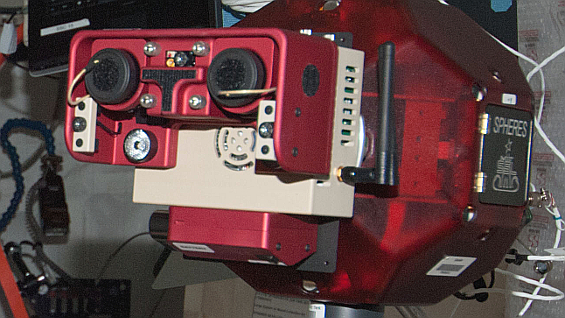
In the vast expanse of space, where human capabilities are tested to the limit, the evolution of robotic vision is making remarkable strides. Recent experiments conducted on the International Space Station (ISS) have unveiled a novel approach—teaching robots to navigate without relying on stereo vision. This intriguing research endeavor not only showcases the power of artificial intelligence but also offers insights into how machines can adapt when faced with sensory challenges. Join us as we delve deeper into this fascinating topic!
Understanding the Challenge: Why Do Robots Struggle with Distance Perception?
Humans have an innate ability to gauge distances, even when deprived of one eye, thanks to years of experience and an extensive repository of contextual knowledge about our surroundings. However, computer vision systems face a unique hurdle; they predominantly depend on depth perception derived from stereo cameras, which do not always function ideally. If a camera encounters an obstruction or fails, the robot’s navigation is compromised, raising significant concerns for applications like self-driving cars.
The Research Breakthrough: One Eye is Enough
To address these challenges, researchers from the European Space Agency and Delft University of Technology initiated a groundbreaking experiment aboard the ISS. They sought to empower robots, specifically SPHERES (Synchronized Position Hold Engage and Reorient Experimental Satellites), to navigate their environment effectively even when operating with one “eye.” This critical investigation aimed to develop robots capable of utilizing their existing knowledge and context to estimate distances without stereo vision.
The Role of Machine Learning
The experiment was ingenious. The SPHERES drones were equipped with stereo cameras to log measurements of their environment. Simultaneously, they engaged in a machine-learning task using only one camera. The crux of the research involved associating visuals captured from the single-camera stream with contextual information already obtained from the stereo imagery.
- For example, if the drone identified a hatch as 4 feet away and 2 feet wide through its stereo cameras, the single-camera stream would work to recognize the shape and its change in size over time, extrapolating the required distance.
- This multifaceted approach mirrors how humans intuitively process visual information based on previous experiences and spatial orientation.
Initial Findings: Progress Amidst Challenges
While the astronauts aboard the ISS have limited time to conduct such experiments, the initial results were promising, despite technical challenges. The distance estimates generated through the single-camera analysis displayed substantial accuracy, signaling a potential breakthrough in robotic navigation systems. However, further advancements are needed to enhance this technique until one-eyed navigation becomes reliable.
Implications for Future Technology
As scientists contemplate the impact of this revolutionary approach, the possibilities are vast. By developing robots that can function proficiently with impaired sensory capabilities, we can expect strides in various industries, including autonomous vehicles, industrial robots, and even space exploration. If robots can learn to navigate with reduced sensory information, it opens new avenues for resilience and functionality.
Conclusion: A Vision for Tomorrow
The journey of teaching robots to navigate with limited visual input is just the beginning of an exciting new chapter in artificial intelligence. As advancements continue, we can anticipate that robots will become better equipped to manage unforeseen challenges, enhancing their utility across numerous applications. The ongoing research highlights that, much like humans, robots can learn adaptation behaviors that might one day lead them to operate with confidence in an unpredictable environment.
At fxis.ai, we believe that such advancements are crucial for the future of AI, as they enable more comprehensive and effective solutions. Our team is continually exploring new methodologies to push the envelope in artificial intelligence, ensuring that our clients benefit from the latest technological innovations.
For more insights, updates, or to collaborate on AI development projects, stay connected with fxis.ai.