
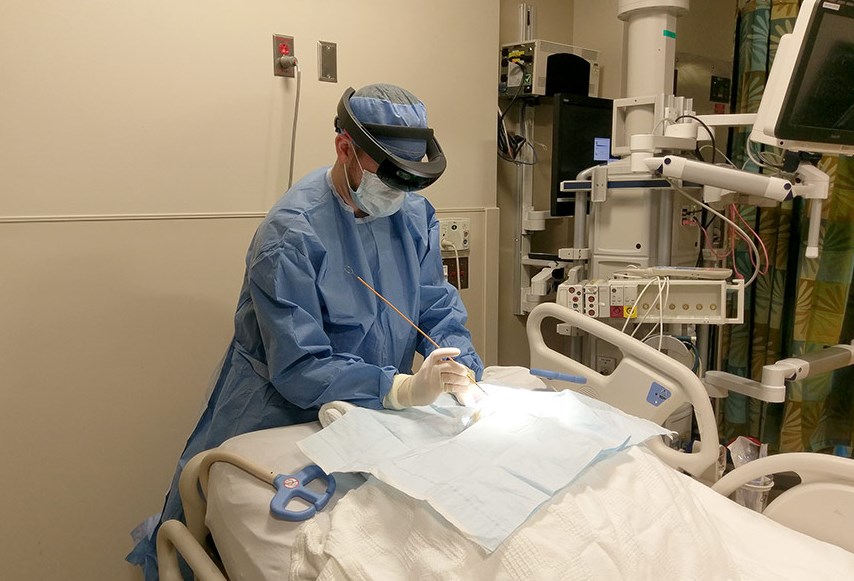
In the realm of medicine, particularly neurosurgery, innovation is paramount. The complexities associated with brain surgeries stem from the intricate and hidden nature of the brain itself. Neurosurgeons face immense challenges, often likening the task to navigating a maze without a map. However, a promising development has emerged—augmented reality (AR) technology in the operating room. At the forefront of this exciting movement are the neurosurgeons at Duke University, who are leveraging the capabilities of Microsoft Hololens to revolutionize how procedures are performed.
The Challenge of “Blind” Surgery
One of the greatest risks in neurosurgery comes from performing what is often referred to as “blind” surgery. During such procedures, surgeons rely on traditional imaging techniques, like CT scans, to guide their actions. For instance, when a catheter is needed to extract pooled fluid deep within the brain, there is ample room for error. In reality, a visible approach is not feasible, and surgeons must take calculated risks to avoid damaging critical brain structures.
How Augmented Reality Enhances Precision
The ingenious approach taken by Andrew Cutler and Shervin Rahimpour involves integrating 3D imaging with AR technology. By utilizing the Hololens, they create a digital overlay of the patient’s brain that illustrates real-time anatomical structures right above the patient’s head. This innovation enables surgeons to visualize their targeted area more effectively and perform procedures with a heightened level of accuracy.
Real-Time Feedback at a Glance
One of the standout features of this AR application is its capability to provide instantaneous data. The Hololens tracks the catheter’s position, allowing the surgeon to manipulate a hologram without interrupting the sterile field in the operating room. Cutler emphasizes, “Since we can manipulate a hologram without actually touching anything, we have access to everything we need.” This means that rather than constantly checking a separate monitor for data, surgeons can focus on their work while benefiting from direct visual guidance.
Benefits and Future Potential
- Enhanced Visualization: The ability to see 3D representations of the brain structures allows for more informed decision-making.
- Minimized Risk: By incorporating AR, the likelihood of damaging vital brain regions is significantly reduced.
- Improved Sterility: Utilizing holograms helps maintain a sterile environment, which is crucial in surgical settings.
While it is still early days for AR in surgery, the technology’s potential is undeniable. The initial tests at Duke have indicated substantial premises for its integration into more scenarios, potentially changing the surgical landscape forever.
Bridging the Gap Between Simulation and Reality
As fascinating as these early experiments are, transitioning from simulation to real-life scenarios will require meticulous validation and trials. However, the early signs point towards AR serving as a beneficial tool for surgeons worldwide. A future where surgeries are not just guided by historical images but enhanced by real-time data and visual overlays is on the horizon.
Conclusion: A New Frontier in Surgical Procedures
Augmented reality in neurosurgery represents a remarkable leap forward in ensuring both patient safety and surgical effectiveness. The efforts of researchers like those at Duke University lay the groundwork for a new era where technology and medicine converge to create groundbreaking solutions. At fxis.ai, we believe that such advancements are crucial for the future of AI, as they enable more comprehensive and effective solutions. Our team is continually exploring new methodologies to push the envelope in artificial intelligence, ensuring that our clients benefit from the latest technological innovations.
For more insights, updates, or to collaborate on AI development projects, stay connected with fxis.ai.