
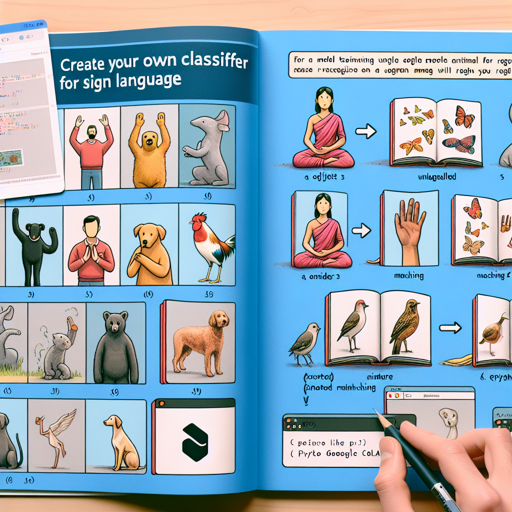
Welcome to the fascinating world of image classification! In this blog, we will guide you on how to create your own image classifier using PyTorch, specifically tailored for recognizing sign language. Whether you’re a beginner or an experienced developer, this user-friendly tutorial will help you get started with minimal fuss.
What is Image Classification?
Image classification is a process where an algorithm identifies what an image represents. Think of it as a smart assistant that can recognize objects or actions in photographs, just like how a child learns to identify animals from a picture book. By training a model with labeled images, it can gain the ability to recognize these items in unlabelled ones.
Getting Started with the Demo
To dive right in, you can run a demo on Google Colab. This platform allows you to write and execute Python code in your browser, making it convenient for testing machine learning models.
Copy and paste the following link to run the demo:
Understanding the Model
The model we’ll be using has been evaluated with a perfect accuracy of 1.0, which means it correctly classifies all test images. Imagine a magician where every trick is performed flawlessly, leaving the audience in awe!
Metrics of the Model
- Task: Image Classification
- Type: Image Classification
- Metrics:
- Name: Accuracy
- Value: 1.0
Testing with Example Images
To test your classifier, you’ll want to use specific images as samples. Here’s a list of example images you can utilize for classification:
 A
A B
B C
C D
D E
E F
F G
G H
H I
I K
K L
L M
M N
N O
O P
P Q
Q R
R S
S T
T U
U V
V W
W X
X Y
Y
Troubleshooting
If you encounter any issues while running the demo or the image classification model, here are some troubleshooting tips:
- Check your code: Review your code for any syntax errors or incorrect references.
- Library versions: Ensure that you’re using the correct versions of necessary libraries like PyTorch.
- Model performance: If the model isn’t achieving the expected accuracy, try retraining it with additional images or improving the quality of the training set.
- Evaluate inputs: Confirm that the images you’re using for testing match the required format and dimensions.
For more insights, updates, or to collaborate on AI development projects, stay connected with fxis.ai.
Conclusion
At fxis.ai, we believe that such advancements are crucial for the future of AI, as they enable more comprehensive and effective solutions. Our team is continually exploring new methodologies to push the envelope in artificial intelligence, ensuring that our clients benefit from the latest technological innovations.