
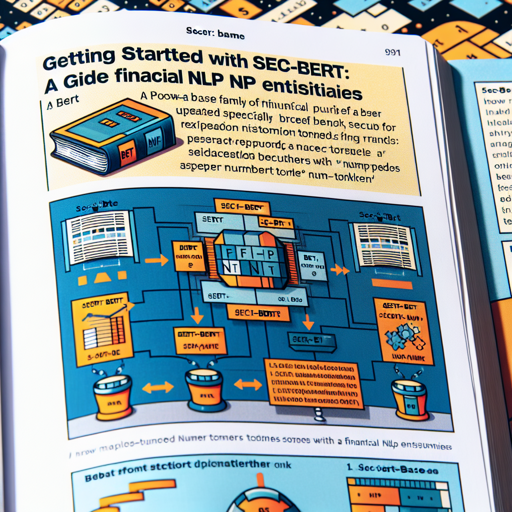
Welcome to this user-friendly guide on how to leverage SEC-BERT, a powerful family of BERT models designed specifically for the financial sector. Whether you’re diving into NLP research or exploring FinTech applications, this article will walk you through the steps to effectively utilize SEC-BERT and troubleshoot potential issues.
What is SEC-BERT?
SEC-BERT is a suite of BERT models tailored for financial documents. It’s engineered to enhance financial natural language processing (NLP) tasks, making it your go-to tool for understanding complex datasets. The package includes:
- SEC-BERT-BASE: The foundation model that mirrors BERT-BASE, fine-tuned on financial documents.
- SEC-BERT-NUM: This variant replaces every number token with a [NUM] pseudo-token, treating numeric expressions uniformly.
- SEC-BERT-SHAPE: Similar to SEC-BERT-NUM but categorizes numbers by their shape using pseudo-tokens.
How to Load the Pre-trained SEC-BERT Model
Loading SEC-BERT is as easy as pie. Follow these simple steps:
from transformers import AutoTokenizer, AutoModel

tokenizer = AutoTokenizer.from_pretrained('nlpaueb/sec-bert-base')
model = AutoModel.from_pretrained('nlpaueb/sec-bert-base')
With just a couple of lines of code, you’ll have access to a pre-trained version of the SEC-BERT model ready for your financial text analysis!
A Fun Analogy to Understand the Code
Think of SEC-BERT as a highly specialized chef in a bustling kitchen (financial NLP). The AutoTokenizer is like the sous chef who prepares the ingredients (your text) in a way that makes it easier to work with. Once the ingredients are ready, the head chef (AutoModel) can create delicious dishes (predictions) with minimal fuss. The combination of these roles allows for a seamless cooking experience, just like how these code snippets provide a smooth entry into using financial NLP with SEC-BERT.
Using SEC-BERT Variants for Predictions
Once your model is loaded, using SEC-BERT for predictions is straightforward. You can input sentences with [MASK] tokens to hold places for words or figures you want the model to predict. For example:
input_text = "Total net sales [MASK] 2% or $5.4 billion during 2019 compared to 2018."
tokenized_input = tokenizer(input_text, return_tensors='pt')
output = model(**tokenized_input)
This way, you can extract valuable insights from your financial documents with precision.
Troubleshooting SEC-BERT
Even the best chefs run into obstacles! Here are some troubleshooting tips to help you navigate potential issues:
- Model Loading Errors: If you experience issues loading the model, ensure your internet connection is stable, and that you’re using the correct model identifier.
- Tokenization Problems: If the text doesn’t seem to be tokenizing correctly, double-check your input format. Ensure that the input strings are clean and free from special characters that the tokenizer can’t process.
- Prediction Anomalies: If the predictions seem off, consider fine-tuning your model or expanding the dataset you’re working with. Both actions can yield more accurate insights.
For more insights, updates, or to collaborate on AI development projects, stay connected with fxis.ai.
Conclusion
SEC-BERT opens up new avenues in financial NLP, allowing you to harness the power of AI in understanding complex financial documents. Don’t forget to explore the different variants and find the one that best fits your needs. At fxis.ai, we believe that such advancements are crucial for the future of AI, as they enable more comprehensive and effective solutions. Our team is continually exploring new methodologies to push the envelope in artificial intelligence, ensuring that our clients benefit from the latest technological innovations.