
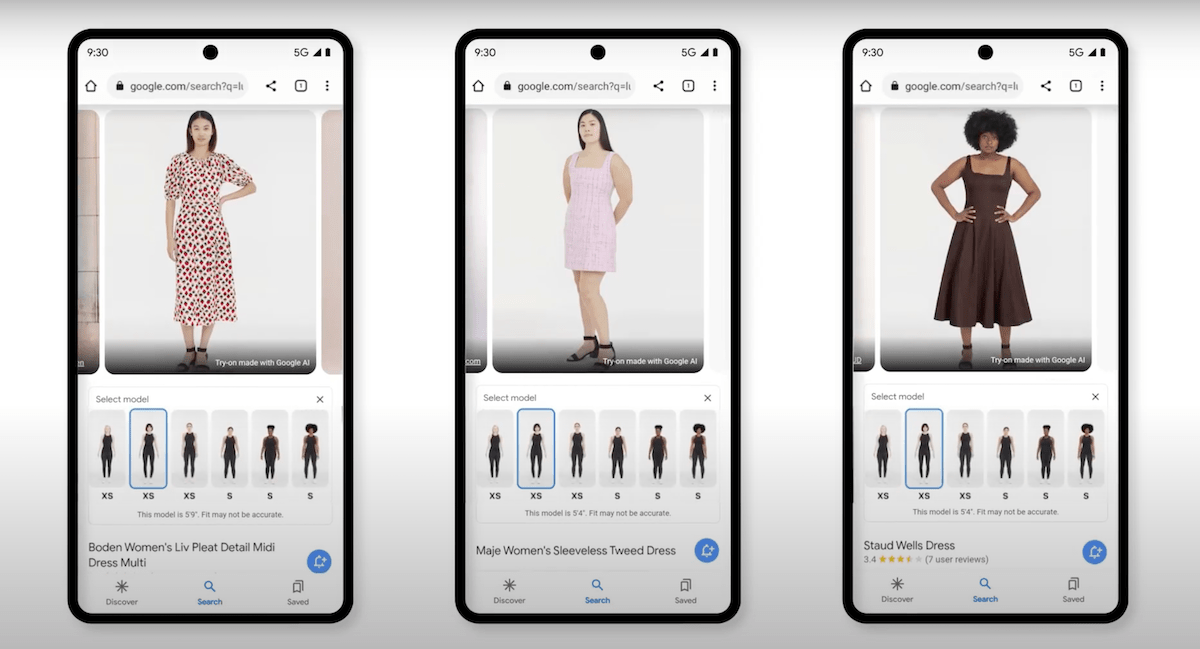
In a digital world where online shopping has become the norm, the challenge of accurately finding the right fit can leave customers deeply frustrated. Traditional e-commerce often fails to deliver the tactile experience of in-store shopping, leading to increased return rates and dissatisfied customers. However, Google is pioneering a solution that could redefine how we shop online: an AI-powered virtual try-on tool, now expanded to include an impressive array of dresses.
The Demand for Dresses
Unveiled on a recent Thursday, Google’s latest enhancement to its generative AI-driven virtual try-on technology comes in response to user demands. Dresses, often falling under the category of desired yet elusive apparel, were repeatedly searched by consumers. Recognizing this trend, Google opted to broaden its offering, now enabling users to virtually adorn themselves in thousands of dresses from various renowned brands, such as Boden, Maje, Sandro, Simkhai, and Staud.
Overcoming Technical Challenges
The complexity of garment design plays a significant role in the development of virtual try-on technology. Unlike simpler items like tops or blouses, dresses possess intricate details and patterns that can confound existing AI models. Previous attempts to employ diffusion techniques struggled when it came to effectively representing the unique textures, prints, and contours that characterize dresses.
- Details Matter: Factors like fabric drape, folds, and silhouette are nuanced in dresses, complicating appearance in virtual formats.
- Pattern Representation: Floral or geometric designs were particularly challenging for low-resolution models, which risked losing critical details.
- Body Comparison: The nature of dresses can obscure body silhouettes, making accurate fittings difficult without advanced modelling techniques.
Innovative Solutions: VTO-UNet Diffusion Transformer
To tackle these challenges, Google has rolled out the VTO-UNet Diffusion Transformer (VTO-UDiT). This cutting-edge technology employs a new training strategy, initially using lower-resolution images before incorporating higher-quality visuals. This approach builds a more robust model that does not compromise on the essential details of the garment.
Additionally, the VTO-UDiT ensures that a person’s bodily features are preserved even when a dress is virtually draped over them. This creates a more authentic representation of how the dress will look while enhancing the shopping experience by providing clearer context.
The Competitive Landscape
As Google boldly steps forward, it joins a competitive market that includes tech giants such as Adobe, Amazon, and Walmart, each launching their own virtual try-on solutions. However, this new expansion hints at Google’s intent not just to participate, but to lead in offering highly advanced features tailored to an increasingly discerning customer base. Virtual try-on technology is not solely about style; it’s a technological response to foster inclusivity in fashion by catering to all body types.
Conclusion: A New Era of Online Shopping
As Google introduces new features to its virtual try-on tool, the implications extend far beyond mere convenience. They usher in a paradigm shift in the online shopping experience as we know it, providing intricate realism that addresses long-standing pain points for consumers. Not only does it elevate the shopping experience, but it also reflects a broader trend toward technology-driven personalization that is progressively becoming the cornerstone of customer engagement.
At fxis.ai, we believe that such advancements are crucial for the future of AI, as they enable more comprehensive and effective solutions. Our team is continually exploring new methodologies to push the envelope in artificial intelligence, ensuring that our clients benefit from the latest technological innovations. For more insights, updates, or to collaborate on AI development projects, stay connected with fxis.ai.