
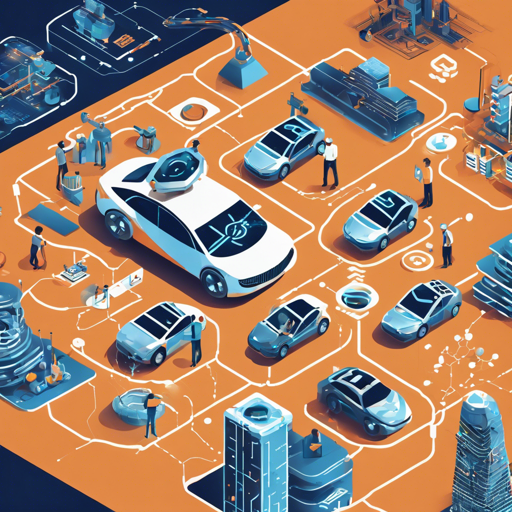
Welcome to your guide on creating projects inspired by the **[Udacity Self-Driving Car Engineer Nanodegree](https://www.udacity.com/courses/self-driving-car-engineer-nanodegree–nd013)**. Here, we will walk you through various self-driving car projects, providing insightful summaries, practical steps to implement them, and troubleshooting tips to assist you during your coding journey.
Overview of Projects
This repository houses the source code for a myriad of fascinating self-driving car projects. Below is a list of exciting projects you can dive into:
|
|
|
|
|---|---|---|
|
|
|
|
|
|
|
|
|
|
|
|


Project Summaries
- P1 – Detecting Lane Lines (basic): Use OpenCV techniques like Hough Transforms to detect lane lines in videos.
- P2 – Traffic Sign Classification: Train a deep neural network using TensorFlow to classify traffic signs.
- P3 – Behavioral Cloning: Utilize a CNN for end-to-end driving in a simulator using techniques to prevent overfitting.
- P4 – Advanced Lane Finding: Create a more sophisticated lane-finding algorithm that accounts for various environmental challenges.
- P5 – Vehicle Detection and Tracking: Develop a comprehensive detection pipeline using HOG and support vector machines.
- P6 – Extended Kalman Filter: Implement Kalman filter in C++ to track the movement of bicycles around your car using lidar and radar.
- P7 – Unscented Kalman Filter: Utilize an unscented Kalman filter with noisy measurements for tracking objects.
- P8 – Kidnapped Vehicle: Apply a particle filter to localize a robot in a new environment.
- P9 – PID Control: Implement a PID controller to adjust the steering angle for maintaining a trajectory.
- P10 – MPC Control: Develop a more advanced MPC controller for optimal steering adjustments.
- P11 – Path Planning: Develop smooth trajectories in a dynamic environment.
- P12 – Road Segmentation: Implement road segmentation with a fully-convolutional network using Python and TensorFlow.
Understanding the Concepts with Analogy
Consider the process of building a self-driving car system like preparing for a fantastic road trip. Each project represents a necessary pit stop along the way:
- Detecting Lane Lines: Think of it as learning to read the road signs that guide you—just like recognizing lane lines keeps you in your lane.
- Traffic Sign Classification: This mimics having an assistant who tells you what every sign means, ensuring you make the right decisions as you drive.
- Behavioral Cloning: Imagine watching an experienced driver. You learn their moves, mimicking their actions to navigate smoothly on different paths—this is precisely what the network does!
- Path Planning: Picture mapping out the best route with various traffic conditions and obstacles, keeping your journey as safe and enjoyable as possible.
Troubleshooting Guide
While working on these projects, you may run into some bumps on the road. Here are a few troubleshooting ideas:
- If your model isn’t training well, ensure that your data preprocessing aligns well with the project goals.
- For slow performance, check if your computational resources like GPU are optimized for deep learning tasks.
- If you encounter issues with the Kalman Filters, double-check your measurement update equations for any discrepancies.
- Always ensure the implementation of your PID or MPC controllers accounts for system dynamics; otherwise, you might end up with erratic vehicle behavior.
For more insights, updates, or to collaborate on AI development projects, stay connected with fxis.ai.
Conclusion
At fxis.ai, we believe that such advancements are crucial for the future of AI, as they enable more comprehensive and effective solutions. Our team is continually exploring new methodologies to push the envelope in artificial intelligence, ensuring that our clients benefit from the latest technological innovations.