
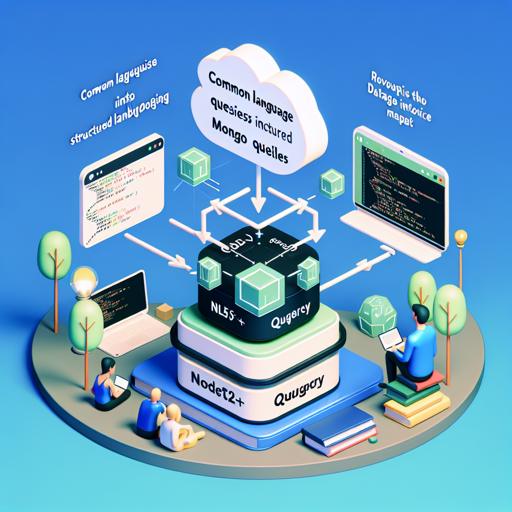
Are you looking to tap into the power of natural language processing (NLP) to generate MongoDB queries? Look no further! In this article, we will guide you step by step on how to use a fine-tuned CodeT5+ model to seamlessly convert natural language queries into MongoDB Query Language (MQL). This innovative tool can save you time and reduce the complexity of database interactions.
What Does the Model Do?
This model, a part of the nl2query repository, is specifically designed to transform your everyday queries into structured MongoDB queries.
https://github.com/Chirayu-Tripathi/nl2queryGetting Started
You can utilize this model by either cloning the GitHub repository or running the following code snippet in your Python environment.
Step-by-Step Implementation
python
from transformers import AutoTokenizer, AutoModelForSeq2SeqLM
import torch

# Load the pre-trained model and tokenizer
model = AutoModelForSeq2SeqLM.from_pretrained('Chirayunl2mongo')
tokenizer = AutoTokenizer.from_pretrained('Chirayunl2mongo')

# Set device to CUDA or CPU
device = torch.device('cuda' if torch.cuda.is_available() else 'cpu')
model = model.to(device)

# Example natural language query
textual_query = "mongo: which cabinet has average age less than 21? titanic: _id, passengerid, survived, pclass, name, sex, age, sibsp, parch, ticket, fare, cabin, embarked"
Now that we have our model set up and ready, it’s time to define the function that will handle the conversion of the natural language query into an MQL query.
Defining the Query Generation Function
def generate_query(
        textual_query: str,
        num_beams: int = 10,
        max_length: int = 128,
        repetition_penalty: int = 2.5,
        length_penalty: int = 1,
        early_stopping: bool = True,
        top_p: int = 0.95,
        top_k: int = 50,
        num_return_sequences: int = 1,
    ) -> str:
        input_ids = tokenizer.encode(
            textual_query, return_tensors='pt', add_special_tokens=True
        )
        device = torch.device('cuda' if torch.cuda.is_available() else 'cpu')
        input_ids = input_ids.to(device)

        generated_ids = model.generate(
            input_ids=input_ids,
            num_beams=num_beams,
            max_length=max_length,
            repetition_penalty=repetition_penalty,
            length_penalty=length_penalty,
            early_stopping=early_stopping,
            top_p=top_p,
            top_k=top_k,
            num_return_sequences=num_return_sequences,
        )

        query = [
            tokenizer.decode(
                generated_id,
                skip_special_tokens=True,
                clean_up_tokenization_spaces=True,
            ) for generated_id in generated_ids
        ][0]
        return query
How It Works
Think of the whole process like a language translator at an airport. You arrive at the airport with a request in your language. The translator (our CodeT5+ model) listens to you and then transforms your words into the language required by the airport authorities (in this case, MongoDB). Just like you need to package your request in a way that the translator understands, your natural language query has to be formatted correctly—for instance, asking about the average age to retrieve data on passengers appropriately.
Using the Function
After defining the function, use it by calling:
mongo_query = generate_query(textual_query)
print(mongo_query)
And there you have it! Your natural language input has now been converted into an MQL query.
Troubleshooting Tips
- If you encounter a device not found error, ensure that you have CUDA installed if you’re trying to use a GPU.
- If your model outputs unexpected results, check the formatting of your input textual query.
- Make sure you have the appropriate version of the transformers library installed.
- For more insights, updates, or to collaborate on AI development projects, stay connected with fxis.ai.
At fxis.ai, we believe that such advancements are crucial for the future of AI, as they enable more comprehensive and effective solutions. Our team is continually exploring new methodologies to push the envelope in artificial intelligence, ensuring that our clients benefit from the latest technological innovations.
Conclusion
With the CodeT5+ model, transforming natural language queries into MongoDB queries can be as easy as having a conversation. By following the above guide, you should be able to streamline your database interactions effectively.