
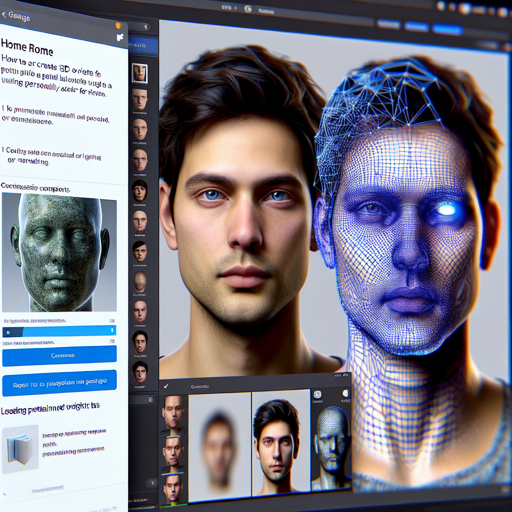
In the digital age, our virtual selves hold as much importance as our real identities. Creating a realistic avatar can bring a new dimension to online experiences. The ROME (Realistic One-shot Mesh-based Head Avatars) project empowers you to generate strikingly lifelike avatars from a single image. This blog will guide you through the process while addressing potential troubleshooting scenarios.
Getting Started with ROME
To successfully create your avatar, you will need to follow a few essential steps:
- Acquire the necessary components.
- Prepare your input image.
- Load the pretrained weights for rendering your avatar.
Step 1: Acquire the Necessary Components
Before diving into the avatar creation process, ensure that you have the following:
- Paper detailing the ROME project.
- Project Page for ROME.
- GitHub Repository to access the code and resources.
- FLAME Model which is required for avatar rendering. More information can be found on the FLAME Project page.
- DECA weights that assist in creating realistic features.
Step 2: Prepare Your Input Image
Your avatar starts with a single image. Choose a clear and high-resolution photo to maximize the quality of the final mesh-based avatar. The image should preferably be a frontal view of your face to achieve the best results.
Step 3: Load Pretrained Weights for Rendering
Utilizing the pretrained weights allows ROME to generate smooth and realistic animations. Here, the analogy of baking a cake comes into play—imagine the photo you provide as the raw ingredients of the cake. However, to turn these ingredients into a finished product, you need quality recipes (pretrained weights) that guide you through the baking process.
# Example Code to load the required models
import torch
from flame import FLAMEModel
from deca import DECA
# Load models
flame_model = FLAMEModel(pretrained=True)
deca_weights = DECA(pretrained=True)
In this analogy, the models and weights serve as your kitchen tools, meticulously designed to help you create a high-quality avatar. Use the library PyTorch to ensure smooth operations while dealing with the complexities of model loading.
Troubleshooting
It’s not uncommon to run into a few bumps while working with models like ROME. Here are some troubleshooting ideas to guide you:
- Check that the versions of PyTorch and related libraries are compatible with the pretrained weights.
- Ensure that your input image conforms to the specifications required by the model.
- If you encounter errors during rendering, verify the installation of dependencies from the GitHub repository.
- Consult the documentation on the Project Page for additional configuration options.
For more insights, updates, or to collaborate on AI development projects, stay connected with fxis.ai.
Conclusion
In adopting this cutting-edge technology, you will not only get a personal avatar but also engage with an exciting intersection of art and technology. At fxis.ai, we believe that such advancements are crucial for the future of AI, as they enable more comprehensive and effective solutions. Our team is continually exploring new methodologies to push the envelope in artificial intelligence, ensuring that our clients benefit from the latest technological innovations.