
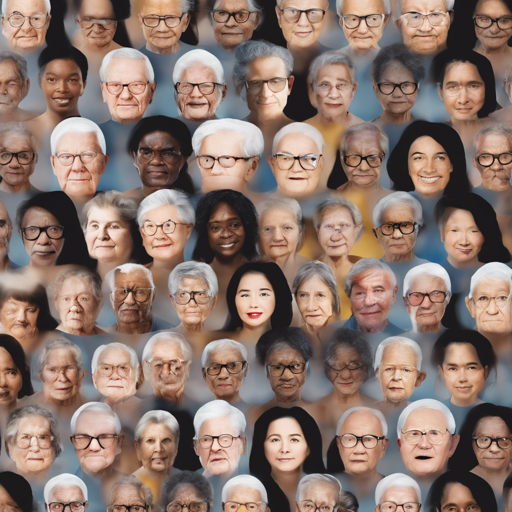
Artificial Intelligence (AI) has made remarkable advancements in image processing, including the ability to classify individuals into age groups based on their facial images. This blog will guide you through understanding how to implement a facial age detection model, interpret its performance, and troubleshoot common issues. Grab your digital camera (or dataset!) and let’s dive into it!
Understanding the Age Detection Model
Imagine you have a wise old owl, capable of seeing your age simply by looking at your face. This is essentially what a well-trained AI model does. Based on facial features, it can categorize people into predefined age groups. The MAE (Mean Absolute Error), along with precision, recall, and F1 score, reveals just how astute this owl truly is.
Key Metrics Explained
- Precision: It tells you how many of the predicted age groups were accurate. For example, if our model predicted 100 individuals as “OLD,” and 95 were actually old, our precision is 95%!
- Recall: This reflects the model’s ability to find all relevant instances. If there are 100 old individuals but our model only identifies 90, our recall is 90%.
- F1-Score: A balance between precision and recall. The closer it is to 1, the better the model performs. Think of it as the average of how often our wise owl is right across all age groups.
Metrics Overview
Here’s a snapshot of the model’s performance:
Classification report:
              precision    recall  f1-score   support
      MIDDLE     0.8162    0.9250    0.8672      1080
      YOUNG      0.9583    0.8511    0.9015      1081
      OLD        0.9537    0.9334    0.9434      1081
    accuracy                         0.9031      3242
    macro avg     0.9094    0.9032    0.9040      3242
weighted avg     0.9094    0.9031    0.9041      3242
The overall accuracy of the model is approximately 90.31%, indicating that our AI can confidently classify most facial images into their respective age groups.
How to Implement Age Classification
To start building your age detection model, follow these steps:
- Gather a dataset of facial images tagged with ages.
- Preprocess the images (resize, normalize, etc.).
- Select a deep learning model suitable for image classification, such as Vision Transformers (ViTs).
- Train the model using the dataset and monitor its performance using the metrics we discussed.
- Evaluate the model’s predictions using the classification report.
Troubleshooting Common Issues
Even the wisest owl can occasionally misread a face. Here are some tips if you encounter issues with your model:
- Low Accuracy? Ensure your dataset is diverse and well-balanced across age groups to prevent bias.
- High False Positives? Tweak the classification thresholds to balance between precision and recall.
- Overfitting? Use techniques like dropout or data augmentation to improve the model’s generalization.
For more insights, updates, or to collaborate on AI development projects, stay connected with fxis.ai.
Conclusion
Though the journey of training an AI to understand human age through facial images may seem daunting, it’s undeniably a fascinating endeavor! Always remember that the key to improvement lies in understanding the performance metrics and refining your model based on data. At fxis.ai, we believe that such advancements are crucial for the future of AI, as they enable more comprehensive and effective solutions. Our team is continually exploring new methodologies to push the envelope in artificial intelligence, ensuring that our clients benefit from the latest technological innovations.