
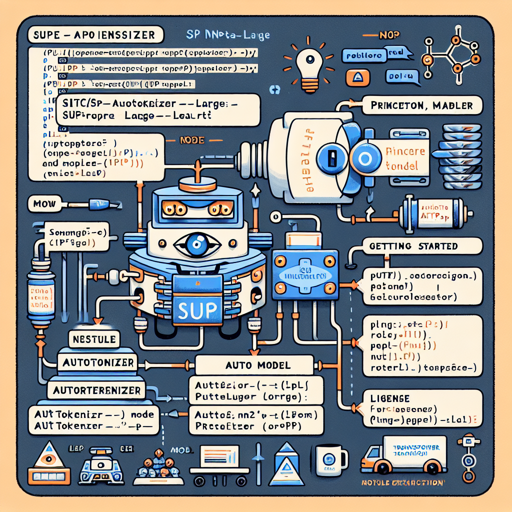
The sup-simcse-roberta-large model, developed by Princeton NLP, is an excellent tool for feature extraction in natural language processing (NLP). This guide will walk you through the essentials of using this model smoothly and effectively.
Model Overview
- Model Type: Feature Extraction
- Parent Model: RoBERTa-large
- License: More information needed
Getting Started
To use the sup-simcse-roberta-large model, you will need to install the necessary package and load the model and tokenizer. Here’s how you can do it:
from transformers import AutoTokenizer, AutoModel

tokenizer = AutoTokenizer.from_pretrained("princeton-nlp/sup-simcse-roberta-large")
model = AutoModel.from_pretrained("princeton-nlp/sup-simcse-roberta-large")
Explanation of the Code
Let’s break down the code snippet above likening it to preparing a spacious, well-organized kitchen for a gourmet meal.
- Importing Ingredients: When you see `from transformers import AutoTokenizer, AutoModel`, it’s like gathering your ingredients and cookware before you start cooking. The AutoTokenizer and AutoModel are the essential tools you need to prepare and manage your data.
- Getting the Right Tools: Next, `tokenizer = AutoTokenizer.from_pretrained(“princeton-nlp/sup-simcse-roberta-large”)` fetches the tokenizer, which is akin to retrieving your chef’s knives. Without them, slicing and dicing your ingredients (or data) would be quite challenging.
- Preparing the Model: In the line `model = AutoModel.from_pretrained(“princeton-nlp/sup-simcse-roberta-large”)`, you get the model itself, comparable to actually hiring a professional chef to take over the cooking process. Now you’re ready to commence the feature extraction process!
Uses of the Model
This model excels in direct feature extraction tasks. It’s essential to note that it should not be used to create hostile or alienating environments for people.
Risks, Biases, and Limitations
As with many language models, it’s crucial to acknowledge the associated risks and bias. Research has shown that predictions may reflect harmful stereotypes. Users should remain vigilant and critically assess the outputs generated by the model.
Training Details
The model was trained using data from English Wikipedia and other substantial datasets, employing both supervised and unsupervised techniques. This diverse training helps it perform well across various tasks.
Troubleshooting Tips
If you encounter issues while implementing the model, here are some ideas to solve common problems:
- Check your Internet Connection: If the model fails to load, ensure you have a stable internet connection as the model needs to be downloaded from the hub.
- Verify Package Compatibility: Make sure you have the latest version of the Transformers library, as older versions may not support the model.
- Inspect Your Code: Carefully review the code for any syntax errors. Even a misplaced character can lead to problems.
- Refer to Documentation: The [GitHub Repository](https://github.com/princeton-nlp/SIMCSE) contains useful information. For further learning, check the [Associated Paper](https://arxiv.org/abs/2104.08821).
For more insights, updates, or to collaborate on AI development projects, stay connected with fxis.ai.
Conclusion
With the sup-simcse-roberta-large model, users have a powerful feature extraction tool at their disposal. Always ensure you understand its capabilities and limitations to make the most of its potential.
At fxis.ai, we believe that such advancements are crucial for the future of AI, as they enable more comprehensive and effective solutions. Our team is continually exploring new methodologies to push the envelope in artificial intelligence, ensuring that our clients benefit from the latest technological innovations.