
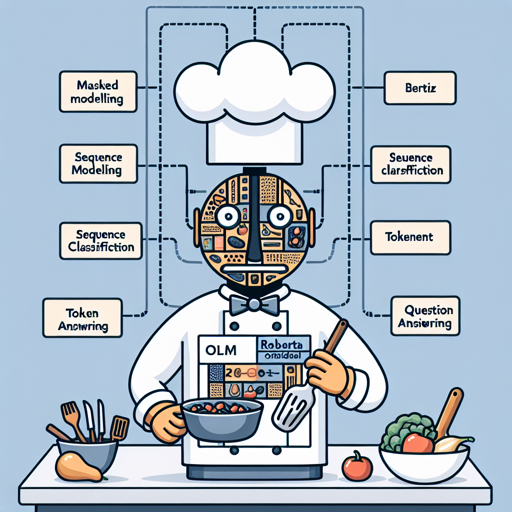
The OLM RoBERTaBERT model is an advanced iteration of the original BERT and RoBERTa models, specifically designed to enhance performance on natural language tasks. It’s trained on a clean snapshot of data from December 2022, enabling it to grasp more recent information, from events like COVID-19 to recent presidential elections. In this guide, we’ll walk you through how to use the OLM RoBERTaBERT model effectively.
1. Intended Uses of OLM RoBERTaBERT
This model is primarily intended for fine-tuning on various downstream tasks, including:
- Masked language modeling
- Sequence classification
- Token classification
- Question answering
2. How to Use OLM RoBERTaBERT
Using the OLM RoBERTaBERT model can be compared to a master chef in a kitchen who has all the essential tools but needs a recipe to create a masterpiece.
Here’s a step-by-step approach:
Step 1: Masked Language Modeling
You can use the model directly with the pipeline for masked language modeling. Here’s how you can get started:
python
from transformers import pipeline

unmasker = pipeline("fill-mask", model="olmolm-roberta-base-dec-2022")
unmasker("Hello I'm a [MASK] model.")
In this code, we create a pipeline for filling in masked words in a sentence. The output would provide you with the potential replacements for the masked token, along with their corresponding confidence scores.
Step 2: Feature Extraction in PyTorch
To get the features for a given text using PyTorch, follow this snippet:
python
from transformers import AutoTokenizer, RobertaModel

tokenizer = AutoTokenizer.from_pretrained("olmolm-roberta-base-dec-2022")
model = RobertaModel.from_pretrained("olmolm-roberta-base-dec-2022")

text = "Replace me by any text you'd like."
encoded_input = tokenizer(text, return_tensors='pt')
output = model(**encoded_input)
This approach enables you to extract feature representations that can be useful for various downstream tasks.
3. Understanding the Datasets
The OLM RoBERTaBERT model is trained using a combination of datasets from Common Crawl and Wikipedia as of December 2022. The training dataset includes a cleaned version of these sources, ensuring consistency and quality:
4. Troubleshooting Common Issues
As with any advanced model, you might encounter some issues while using OLM RoBERTaBERT. Here are a few troubleshooting tips:
- Memory Errors: If you receive memory-related errors, consider reducing the size of your input data or using a smaller batch size.
- Installation Issues: Ensure that your packages are updated and correctly installed. You might want to reinstall the
transformerslibrary. - Performance Lag: If the model is performing slowly, check your hardware setup; models of this size benefit greatly from GPUs.
For more insights, updates, or to collaborate on AI development projects, stay connected with fxis.ai.
5. Training Insights
The training of the OLM RoBERTaBERT model adhered to the guidelines established by previous versions. The performance on the GLUE benchmark has shown competitive results, outperforming the original BERT on several tasks:
| Task | Metric | Original BERT | OLM RoBERTa Dec 2022 (Ours) |
|---|---|---|---|
| cola | mcc | 0.5889 | 0.28067 |
| sst2 | acc | 0.9181 | 0.9275 |
| mrpc | accf1 | 0.9182 | 0.9033 |
Conclusion
Utilizing the OLM RoBERTaBERT model empowers you to build robust natural language processing applications that can stay attuned to recent developments. Whether it’s for classification or feature extraction, this guide lays the groundwork for getting started.
At fxis.ai, we believe that such advancements are crucial for the future of AI, as they enable more comprehensive and effective solutions. Our team is continually exploring new methodologies to push the envelope in artificial intelligence, ensuring that our clients benefit from the latest technological innovations.