
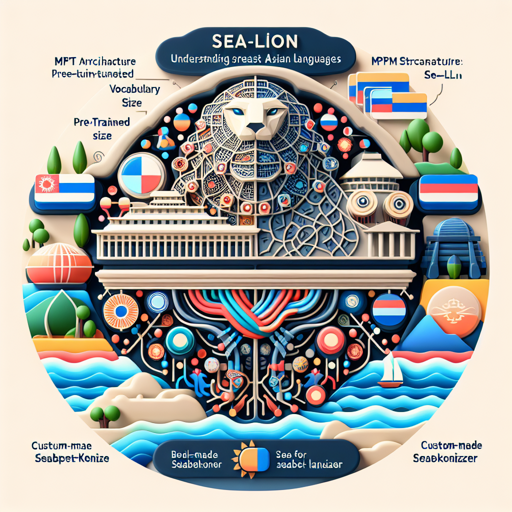
Welcome to your guide on the SEA-LION language model—an innovative solution tailored for understanding Southeast Asian languages. In this article, we will walk you through the key components of this powerful model, how to utilize it effectively, and essential troubleshooting tips to ensure a smooth experience.
Understanding SEA-LION
SEA-LION stands for “Southeast Asian Languages In One Network”. This model showcases a range of Large Language Models (LLMs) pre-trained and fine-tuned specifically to cater to the diverse linguistic landscape of Southeast Asia. With models ranging from 3 to 7 billion parameters, SEA-LION aims to bridge language barriers and enhance communication across the region.
Model Details
SEA-LION is built upon the MPT architecture and boasts a vocabulary size of 256K. The model utilizes the SEABPETokenizer, custom-designed for Southeast Asian languages, ensuring that it effectively captures the nuances of the region.
Performance Benchmarks
Using general tasks in English as a yardstick, SEA-LION has an average performance with key metrics outlined below:
 Model        ARC    HellaSwag  MMLU   TruthfulQA  Average
SEA-LION 7B  39.93  68.51      26.87       35.09  42.60
Training Data
The SEA-LION model was trained using a massive dataset of 980 billion tokens, drawn from various sources to ensure comprehensive coverage of Southeast Asian languages.
How to Use SEA-LION
- Integrate SEA-LION into Your Application: To start leveraging SEA-LION, you can access its models through the provided GitHub repository.
- Implement Tokenization: Make sure to use the SEABPETokenizer to facilitate accurate tokenization of your input data.
- Fine-tune the Model: Fine-tuning with relevant datasets can significantly enhance the model’s performance for your specific use case.
Analogies to Grasp SEA-LION Usage
Think of using SEA-LION similar to learning to ride a bike. Initially, you require a properly fitted bike (the model), understand how the gears work (fine-tuning), and learn to balance (tokenization). As you practice, you will improve, allowing you to navigate various paths (applications) confidently. Just like you might encounter obstacles (issues) while riding, being aware of potential troubleshooting methods can ensure a smoother journey.
Troubleshooting Tips
If you experience difficulties while using the SEA-LION model, here are some handy troubleshooting ideas:
- Performance Issues: If the model is underperforming, double-check your data quality and preprocessing steps.
- Tokenization Problems: Ensure that you’re using the SEABPETokenizer as intended. A mishap here could lead to significant differences in model performance.
- Technical Errors: Review the configuration and hyperparameters you’ve set to match those recommended in the documentation.
For more insights, updates, or to collaborate on AI development projects, stay connected with fxis.ai.
Conclusion
At fxis.ai, we believe that such advancements are crucial for the future of AI, as they enable more comprehensive and effective solutions. Our team is continually exploring new methodologies to push the envelope in artificial intelligence, ensuring that our clients benefit from the latest technological innovations.