
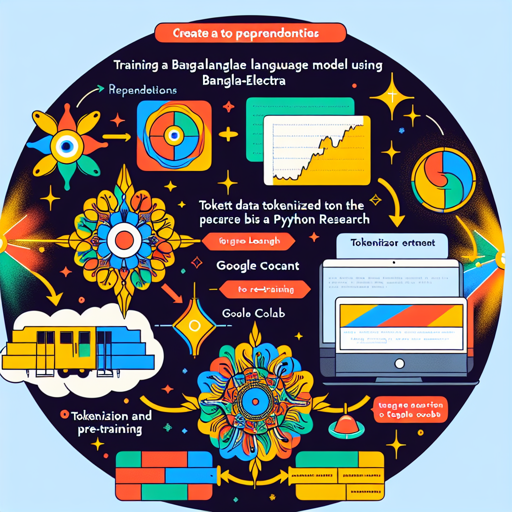
In this article, we will guide you step-by-step on how to train a Bangla language model utilizing Bangla-Electra. This approach, based on Google Research’s ELECTRA, promises a significant impact on natural language processing tasks for the Bangla language. Let’s dive in!
Prerequisites
- Basic understanding of machine learning concepts
- Familiarity with Python programming language
- An active Google account to access Google Colab
Getting Started with Bangla-Electra
First, we will explore the various components involved in training your own Bangla language model.
Tokenization and Pre-training
The first step involves tokenizing your text data. Pre-training is crucial as it helps the model learn the structure and nuances of the Bangla language.
You can find the pre-training and tokenization Colab notebook here. This notebook walks you through:
- Running 120,000 steps for V1 and 190,000 steps for V2 to refine model performance.
Classification with SimpleTransformers
Next, let’s talk about classification tasks. For this part, you would utilize SimpleTransformers. It is highly recommended for evaluating your model’s accuracy against various benchmarks.
You can access the classification Colab notebook here. Notably, Soham Chatterjee’s news classification task reported the following accuracy rates:
- Random: 16.7%
- mBERT: 72.3%
- Bangla-Electra: 82.3%
This shows how Bangla-Electra performs comparably to mBERT on various tasks and configurations.
Question Answering
Want to expand your model’s capabilities? You can also implement it for question answering tasks using the TyDi dataset. You can find the necessary notebook here. This step will enhance the interaction capabilities of your Bangla language model.
Corpus and Vocabulary
To build your model, you will need a rich corpus. The Bangla-Electra model is trained on:
- A deduplicated web crawl from oscar-corpus.com (5.8GB)
- A dump from July 1, 2020, of bn.wikipedia.org (414MB)
The vocabulary file, named vocab.txt, is included in the upload with a vocabulary size of 29,898. This aspect is pivotal for the model’s understanding of the language.
Troubleshooting
While training your model, you may encounter challenges. Here are some troubleshooting ideas:
- Issue: Model Training Crashes
Ensure your Google Colab session has enough resources allocated, like high-RAM options.
- Issue: Poor Model Performance
Consider reviewing the training steps and datasets. It might be beneficial to adjust the number of training steps or augment your corpus.
- Issue: Vocabulary Not Recognized
Check if the vocab.txt file is properly referenced in your code.
For more insights, updates, or to collaborate on AI development projects, stay connected with fxis.ai.
Conclusion
With Bangla-Electra, we have a valuable tool for advancing the field of natural language processing for Bangla. By following these steps, you can develop a model that not only understands but engages with the language effectively. At fxis.ai, we believe that such advancements are crucial for the future of AI, as they enable more comprehensive and effective solutions. Our team is continually exploring new methodologies to push the envelope in artificial intelligence, ensuring that our clients benefit from the latest technological innovations.