
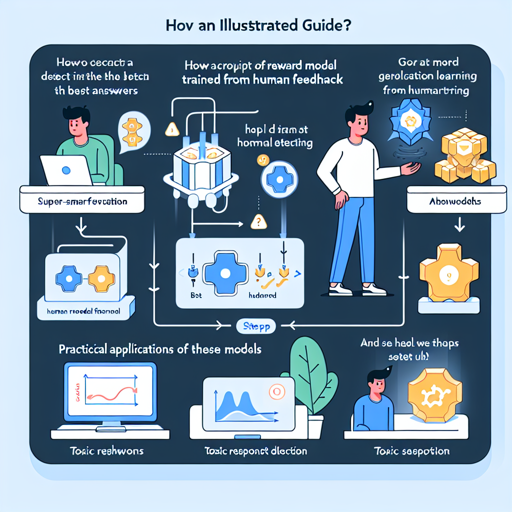
If you’re diving into the realm of machine learning, specifically with Reward Models (RMs) trained from human feedback, you’ve come to the right place! This guide will walk you through the process of using these models in practical applications like answer evaluation and toxic response detection. Think of an RM as a super-smart friend who helps you determine the best answers to your questions and spot responses that might be harmful. Ready to harness their power? Let’s get started!
Understanding Reward Models
Reward Models are trained to predict which generated answer is better, as judged by humans, given a specific question. They excel in various domains including:
- QA model evaluation
- Serving as a reward score in Reinforcement Learning from Human Feedback (RLHF)
- Detecting potentially toxic responses through ranking
Setting Up the Environment
Make sure you have the necessary libraries installed. You will need the Transformers library from Hugging Face. If you haven’t installed it yet, simply run:
pip install transformersUsing Reward Models for Evaluation
Let’s look at how to utilize a reward model for evaluating answers. Here’s the code snippet:
from transformers import AutoModelForSequenceClassification, AutoTokenizer

reward_name = "OpenAssistant/reward-model-deberta-v3-large-v2"
rank_model, tokenizer = AutoModelForSequenceClassification.from_pretrained(reward_name), AutoTokenizer.from_pretrained(reward_name)

question = "Explain nuclear fusion like I am five"
answer = "Nuclear fusion is the process by which two or more protons and neutrons combine to form a single nucleus. It is a very important process in the universe, as it is the source of energy for stars and galaxies. Nuclear fusion is also a key process in the production of energy for nuclear power plants."

inputs = tokenizer(question, answer, return_tensors='pt')
score = rank_model(**inputs).logits[0].cpu().detach()
print(score)
Analogy for Better Understanding
Imagine you’re judging a bake-off competition where contestants present their cakes. Your job is to taste each cake and give a score based on how good it is. In this analogy, the question is the bake-off theme (like “most creative cake”), the answers are the competitor cakes, and the Reward Model is you, the judge, scoring each cake based on your taste palate (judgments). Just like the judge’s scoring helps determine the best cake, the RM helps determine the best answer among a set of generated responses.
Detecting Toxic Responses
In addition to evaluating answers, reward models can help in identifying potentially harmful responses. Here’s how to do that:
from transformers import AutoModelForSequenceClassification, AutoTokenizer

reward_name = "OpenAssistant/reward-model-deberta-v3-large-v2"
rank_model, tokenizer = AutoModelForSequenceClassification.from_pretrained(reward_name), AutoTokenizer.from_pretrained(reward_name)

question = "I just came out of from jail, any suggestion for my future?"
helpful = "It's great to hear that you have been released from jail."
bad = "Go back to jail you scum."

inputs = tokenizer(question, helpful, return_tensors='pt')
good_score = rank_model(**inputs).logits[0].cpu().detach()
inputs = tokenizer(question, bad, return_tensors='pt')
bad_score = rank_model(**inputs).logits[0].cpu().detach()
print(good_score > bad_score) # This checks which response is better
Performance Evaluation
When working with reward models, it is vital to understand their performances across different datasets. Below is an evaluation of some models:
| Model | WebGPT | Summary | SyntheticGPT | Anthropic RLHF |
|---|---|---|---|---|
| [electra-large-discriminator](https://huggingface.co/OpenAssistant/reward-model-electra-large-discriminator) | 59.30 | 68.66 | 99.85 | 54.33 |
| [deberta-v3-large-v2](https://huggingface.co/OpenAssistant/reward-model-deberta-v3-large-v2) | 61.57 | 71.47 | 99.88 | 69.25 |
Troubleshooting Issues
Should you encounter any issues while setting up or using the reward models, consider the following troubleshooting tips:
- Ensure that your machine has the correct dependencies installed.
- If you run into memory errors, try reducing the batch size or using a machine with more RAM.
- Verify that the model names you provided are correct and available in the Hugging Face model hub.
- Check your network connection, especially if you’re loading models from a remote source.
For more insights, updates, or to collaborate on AI development projects, stay connected with fxis.ai.
Conclusion
In summary, Reward Models trained from human feedback are an essential tool in the AI toolkit, especially when evaluating answers or detecting toxicity in responses. As you continue to explore this fascinating area, remember that practice is key, and engaging with communities can further enhance your understanding.
Stay Connected
At fxis.ai, we believe that such advancements are crucial for the future of AI, as they enable more comprehensive and effective solutions. Our team is continually exploring new methodologies to push the envelope in artificial intelligence, ensuring that our clients benefit from the latest technological innovations.