
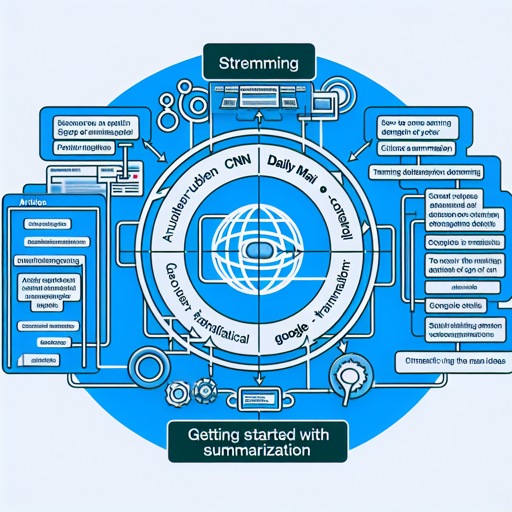
In the world of AI and data science, summarizing data efficiently can save precious time and help convey information succinctly. Today, we’ll explore how to utilize the arubenrubencnn_dailymail_google_translator dataset effectively for summarization tasks. This guide is designed to be user-friendly, ensuring that you can dive straight into this innovative technology!
Understanding the Dataset
The arubenrubencnn_dailymail_google_translator dataset is a rich collection tailored for those who want to work on summarization projects. Think of it as a vast library packed with books (articles, in this case) that tell stories. Your goal is to craft a concise summary of these books, representing the core message whilst leaving out the extraneous details.
Getting Started with Summarization
- Step 1: Install the necessary libraries. You’ll need frameworks like Transformers and Datasets from Hugging Face.
- Step 2: Load the dataset into your program. This is akin to opening a book – once it’s open, you can start reading (or in this case, analyzing).
- Step 3: Set up a summarization pipeline. You can think of this pipeline as a conveyor belt that processes the content for you, swiftly converting lengthy text into digestible summaries.
- Step 4: Run your summarization task on the dataset. Here, you’ll witness your pipeline in action, much like a chef cooking the perfect dish from raw ingredients.
Example Code
The following code snippet provides an example of how to load and summarize data from the dataset.
from transformers import pipeline
summarizer = pipeline("summarization")

example_text = "Your lengthy article text here."
summary = summarizer(example_text, max_length=50, min_length=25, do_sample=False)
print(summary)
Breaking the Code Down
This code works similarly to a barista making a custom coffee order for each customer. Here’s how:
- Firstly, you import the
pipelinefrom the Transformers library, as a barista gathers their tools. - Next, you create a summarizer instance; think of this as programming the machine that will whip up your perfect coffee.
- You’ll provide a lengthy text (just like an order) for summarization.
- Finally, by running the summarizer, you get a concise summary (the delightful cup of coffee) ready for you to enjoy!
Troubleshooting
If you run into issues while utilizing the dataset or the summarization process, here are some steps to troubleshoot effectively:
- Check your dependencies: Ensure that all necessary libraries are correctly installed and up-to-date.
- Data format errors: If the input data format does not match expectations, double-check the data you’re feeding into the summarizer.
- Performance issues: If the summarization process is too slow, consider optimizing your model settings or using a smaller dataset to get started.
For more insights, updates, or to collaborate on AI development projects, stay connected with fxis.ai.
Final Thoughts
Using the arubenrubencnn_dailymail_google_translator dataset paves the way for developing effective summarization models that can tackle lengthy articles efficiently. By following this friendly guide, you’ll be well on your way to mastering summarization techniques in no time. At fxis.ai, we believe that such advancements are crucial for the future of AI, as they enable more comprehensive and effective solutions. Our team is continually exploring new methodologies to push the envelope in artificial intelligence, ensuring that our clients benefit from the latest technological innovations.