
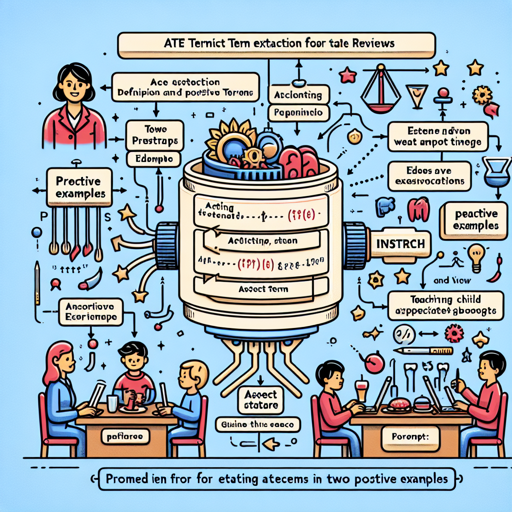
Welcome to our guide on utilizing the ATE Tk-Instruct model, a state-of-the-art (SOTA) model designed specifically for Aspect Term Extraction (ATE) tasks in sentiment analysis. In this article, we will explore how to effectively implement this model, discuss the underlying training data, and provide troubleshooting tips to enhance your experience.
Understanding the Model
The ATE Tk-Instruct model is finetuned for extracting aspect terms from reviews in the restaurant domain. This process involves using prompts that both define the task and provide examples. Here’s how it works:
- The model is trained using prompts structured as: **definition + 2 positive examples**.
- These prompts help guide the model to achieve better results by educating it on what constitutes an expected output when analyzing input reviews.
Consider it like teaching a child to identify fruits: you first show them what an apple and a banana look like, then you ask them to spot these fruits in a basket full of other items.
Training Data
This model is trained on the SemEval 2014 benchmark dataset, which includes reviews from both laptops and restaurants, enriched with aspect term and polarity labels. You can access the dataset here.
Setting Up the ATE Tk-Instruct Model
To get started, you will need to implement the model using the official code from the paper titled InstructABSA: Instruction Learning for Aspect Based Sentiment Analysis. It contains the essential components to input your review and extract the relevant aspects. Below is a general guide:
- Clone the repository from GitHub.
- Ensure you have all dependencies installed, such as the necessary libraries for natural language processing.
- Input your review data in the required format outlined in the documentation.
- Run the model and collect the extracted aspect terms.
Troubleshooting Tips
If you encounter any issues during the implementation, here are some tips to resolve them:
- Check your input data format: Ensure that your reviews follow the expected structure.
- Verify that all dependencies are correctly installed and compatible with your Python version.
- If the model runs slowly, try optimizing your environment or using a more powerful machine.
For more insights, updates, or to collaborate on AI development projects, stay connected with fxis.ai.
Conclusion
At fxis.ai, we believe that such advancements are crucial for the future of AI, as they enable more comprehensive and effective solutions. Our team is continually exploring new methodologies to push the envelope in artificial intelligence, ensuring that our clients benefit from the latest technological innovations.