
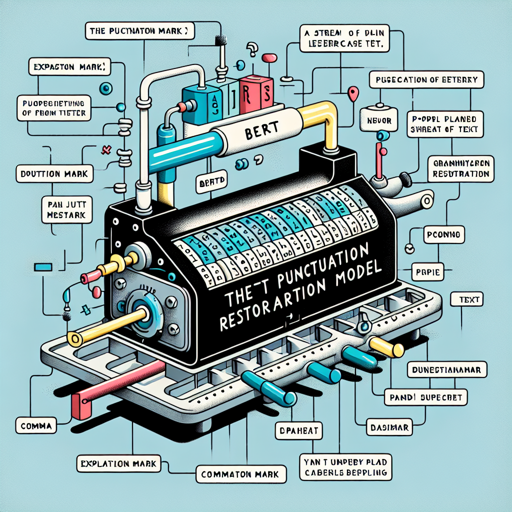
In this tutorial, we’ll dive into a powerful tool that employs the BERT architecture to restore punctuation in text, a task that might sound daunting but is essential for generating coherent outputs from unpunctuated input. Let’s explore how this model works and how you can easily implement it in your projects.
What is the BERT Punctuation Restoration Model?
The BERT-based punctuation restoration model is fine-tuned specifically for converting plain, lowercased text into a grammatically correct form by adding the necessary punctuation marks and capitalizations. Whether you’re transcribing speech via ASR or working with text that’s lost its punctuation, this model comes to the rescue!
The model restores various punctuations, including:
- Exclamation mark (!)
- Question mark (?)
- Period (.)
- Comma (,)
- Dash (-)
- Colon (:)
- Semicolon (;)
- Apostrophe (‘)
How to Get Started
Here are simple steps to get this model up and running:
- First, install the necessary package by running the following command:
- Next, use the sample Python code below to see the model in action:
- The above code takes unpunctuated text and outputs a correctly punctuated version, highlighting the power of this model.
pip install rpunctfrom rpunct import RestorePuncts
# The default language is 'english'
rpunct = RestorePuncts()
output = rpunct.punctuate("""in 2018 cornell researchers built a high-powered detector that in combination with an algorithm-driven process called ptychography set a world recordby tripling the resolution of a state-of-the-art electron microscope as successful as it was that approach had a weakness it only worked with ultrathin samples that werea few atoms thick anything thicker would cause the electrons to scatter in ways that could not be disentangled now a team again led by david muller the samuel b eckertprofessor of engineering has bested its own record by a factor of two with an electron microscope pixel array detector empad that incorporates even more sophisticated3d reconstruction algorithms the resolution is so fine-tuned the only blurring that remains is the thermal jiggling of the atoms themselves""")
print(output)Understanding the BERT Model: An Analogy
Imagine you’re hosting a dinner party and have invited guests who speak different languages. As they converse, some guests might forget to use polite phrases, and others might mumble their words. Your job is to interject smoothly, transforming their speech into refined dialogue that everyone can understand. Similarly, the BERT punctuation restoration model listens to the “mumbled” sentences (text without punctuation) and adds the necessary pauses and emphases (punctuation and capitalization) to make the conversation clearer and more enjoyable for the audience.
Training Data and Model Performance
This model has been fine-tuned utilizing a substantial dataset of 560,000 product reviews from Yelp. The results have shown commendable performance with an F1 accuracy rate of 90%. With this level of precision, the BERT model significantly enhances the text quality, making it a go-to choice for various applications.
Troubleshooting Tips
If you encounter any issues while using the BERT punctuation restoration model, here are some troubleshooting ideas:
- Ensure that you have installed the latest version of the
rpunctpackage. - Check your input text to confirm it’s in the proper format (plain text without punctuation).
- If your program returns an error, try running it with a smaller input text to see if the problem persists.
- Review any dependencies that may be missing for your development environment.
For more insights, updates, or to collaborate on AI development projects, stay connected with **fxis.ai**.
Conclusion
Using the BERT model for punctuation restoration can dramatically improve the readability and coherence of your text. Don’t hesitate to experiment with your datasets and applications! At **fxis.ai**, we believe that such advancements are crucial for the future of AI, as they enable more comprehensive and effective solutions. Our team is continually exploring new methodologies to push the envelope in artificial intelligence, ensuring that our clients benefit from the latest technological innovations.