
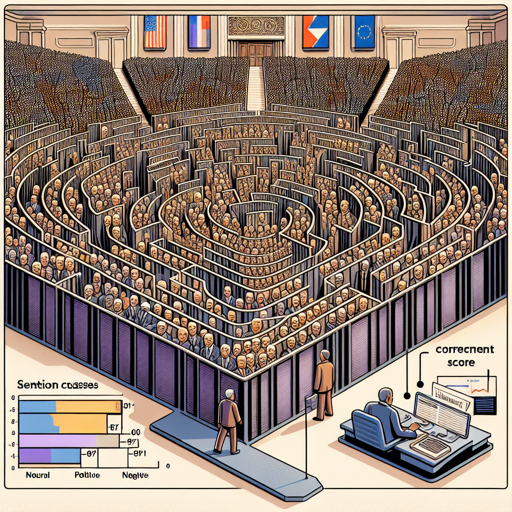
Welcome to our insightful guide on utilizing the huBERT model for sentiment analysis in political communications. This model has been fine-tuned specifically for Hungarian parliamentary pre-agenda speeches and is adept at classifying text into neutral, positive, and negative sentiments.
Getting Started with huBERT
Before diving into the implementation, let’s clarify the core components of the model:
- Model Name: huBERT
- Metrics: It boasts an impressive F1 Score of 0.91.
- Use Cases: It can classify sentiments in various political texts and speeches efficiently.
How To Use the huBERT Model
Using the huBERT model can be visualized as navigating a complex maze. The walls of the maze represent different sentiment classes, and by utilizing the model, you can identify the correct path to your desired sentiment outcome.
Here’s how you can implement huBERT in Python:
from transformers import AutoTokenizer, AutoModelForSequenceClassification

# Load the tokenizer and model
tokenizer = AutoTokenizer.from_pretrained("poltextlab/HunEmBERT3")
model = AutoModelForSequenceClassification.from_pretrained("poltextlab/HunEmBERT3")

# Example of how to use the model
input_text = "A vegetációs időben az országban rendszeresen jelentkező jégesők ellen is van mód védekezni lokálisan."
inputs = tokenizer(input_text, return_tensors="pt")
outputs = model(**inputs)
Model Training and Performance
This model has been refined using a dataset of parliamentary speeches, categorizing sentiments primarily as:
- Neutral
- Positive
- Negative
The training has produced precise results with a weighted F1 score standing at 0.91, showcasing its ability to understand sentiments accurately.
Troubleshooting Tips
If you encounter any issues while implementing the huBERT model, consider the following:
- Error Messages: Check for typos in the model name or tokenizer paths.
- Model Loading Failures: Ensure you have a stable internet connection as the model needs to be downloaded from Hugging Face.
- Inaccurate Predictions: Experiment with different texts or check the preprocessing of your input data to ensure it matches what the model was trained on.
For more insights, updates, or to collaborate on AI development projects, stay connected with fxis.ai.
Conclusion
At fxis.ai, we believe that such advancements are crucial for the future of AI, as they enable more comprehensive and effective solutions. Our team is continually exploring new methodologies to push the envelope in artificial intelligence, ensuring that our clients benefit from the latest technological innovations.