
Welcome to the exciting world of Natural Language Processing (NLP) tailored for Ancient Greek! In this article, we’ll explore how to utilize the MicroBERT model, designed specifically for this classical language, and how you can effectively engage with it. Let’s embark on this linguistic journey!
What is MicroBERT?
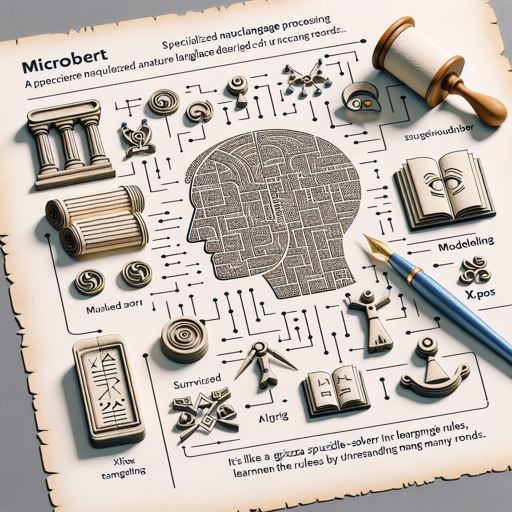
MicroBERT is a specialized model designed for Ancient Greek. With its suffix **-mx**, it indicates that the training process involved supervised learning through masked language modeling and XPOS (part-of-speech) tagging. Essentially, it aims to understand the context and structure of Ancient Greek texts, much like a puzzle solver who learns the rules of the game by playing many rounds.
Getting Started with MicroBERT
To begin using MicroBERT, follow these steps:
-
1. Install the Model
First, clone the repository where MicroBERT is hosted:
git clone https://github.com/lgessler/microbert -
2. Setup Your Environment
Ensure you have the required libraries and environment settings by following the instructions provided in the README of the repository.
-
3. Load the Data
You will need to source your Ancient Greek data. This includes unlabeled data from the Diorisis corpus, which contains a massive 9,058,227 tokens.
-
4. Train MicroBERT
Utilize the UD treebank for labeled data, which offers 213,999 tokens to ensure your model learns accurately.
-
5. Start Inference
Once trained, you can start making predictions and studying the outcomes of your model on various Ancient Greek texts!
Understanding the Model with an Analogy
Think of the MicroBERT model as an ancient librarian who has spent years categorizing and memorizing a vast collection of scrolls. Each scroll represents an Ancient Greek text, filled with intricate language and meaning. The librarian not only remembers the content but also understands the structure, grammar, and nuances of language use. Just as the librarian can accurately summarize any scroll or answer specific queries, MicroBERT analyzes and processes Ancient Greek texts for insightful results.
Troubleshooting Common Issues
As with any advanced model, you might face some bumps on the road. Here are some common issues and how to address them:
-
Model not Training Properly
Ensure your data is correctly formatted and that there are no missing tokens in both your labeled and unlabeled datasets.
-
Performance Issues
If the model is running slowly, consider optimizing your computational resources or checking the performance settings.
-
Installation Errors
Double-check that all dependencies are installed. Consult the repository’s README for troubleshooting installation issues.
For more insights, updates, or to collaborate on AI development projects, stay connected with fxis.ai.
Conclusion
MicroBERT stands at the intersection of ancient linguistics and cutting-edge technology. By harnessing this model, you can delve into the depths of Ancient Greek with modern tools. Remember, experimenting and refining your approach is key in the journey of AI exploration.
At fxis.ai, we believe that such advancements are crucial for the future of AI, as they enable more comprehensive and effective solutions. Our team is continually exploring new methodologies to push the envelope in artificial intelligence, ensuring that our clients benefit from the latest technological innovations.