
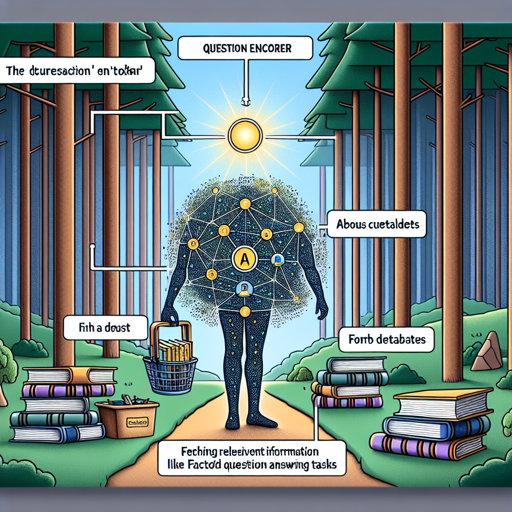
Exploring the realms of Natural Language Processing (NLP) can sometimes feel akin to finding your way through a dense forest—you need the right tools to help you navigate. One such tool is the RAG-Token Model. In this article, we’ll dissect the workings of the RAG-Token Model and demonstrate how to implement it for your own factoid question answering tasks.
Understanding the RAG-Token Model
The RAG (Retrieval-Augmented Generation) Token Model is designed to leverage external knowledge from datasets, such as those found in Wikipedia, to provide accurate and informative answers to questions. Imagine it as a knowledgeable librarian: it doesn’t just memorize facts; it knows how to fetch relevant books (or passages) based on the questions you ask.
This model operates using three main components:
- Question Encoder: This part processes the questions you set forth.
- Retriever: It fetches the most relevant passages from the dataset, like pulling books from the library shelves based on the question asked.
- Generator: It then synthesizes a coherent answer from the retrieved information, much like summarizing key points from the books.
Setting Up the RAG-Token Model
Before diving into the usage example, ensure you have the necessary Python libraries installed, specifically the `transformers` library. Once you have that ready, you can set up the model by following these simple steps:
from transformers import RagTokenizer, RagRetriever, RagTokenForGeneration

# Initialize the tokenizer
tokenizer = RagTokenizer.from_pretrained("facebook/rag-token-nq")

# Initialize the retriever with a dummy dataset
retriever = RagRetriever.from_pretrained("facebook/rag-token-nq", index_name="exact", use_dummy_dataset=True)

# Initialize the model itself
model = RagTokenForGeneration.from_pretrained("facebook/rag-token-nq", retriever=retriever)
Generating Answers
With the model set up, you’re ready to generate answers to your questions. Here’s how you can do it:
# Prepare the input question
input_dict = tokenizer.prepare_seq2seq_batch("who holds the record in 100m freestyle", return_tensors="pt")

# Generate the answer
generated = model.generate(input_ids=input_dict["input_ids"])

# Decode the answer
print(tokenizer.batch_decode(generated, skip_special_tokens=True)[0])  # should give michael phelps => sounds reasonable
Analogy Time: The RAG Model in Action
Imagine you’re in a trivia night competition. You’ve got a question but no idea about the answer. Here’s how each component of the RAG-Token Model works:
- **Question Encoder**: This is you, trying to remember the question. You phrase it clearly so that it makes sense.
- **Retriever**: This is your friend who rushes to the shelves (the wiki_dpr dataset) to find the best book that might contain the answer. They’re scanning for the relevant information related to your question.
- **Generator**: Now that your friend is back with the book, they summarize the content for you, allowing you to confidently shout out the answer to the trivia question.
Troubleshooting Common Issues
While the RAG-Token Model is powerful, you might encounter some hiccups along the way. Here are a few troubleshooting tips:
- Memory Issues: The full legacy index requires over 75 GB of RAM. Use the dummy dataset to avoid crashes.
- Model Not Importing: Ensure that you have installed the `transformers` library correctly and that your Python environment is up to date.
- Slow Response Times: If the model is slow, ensure you’re not running it on an overloaded machine.
For more insights, updates, or to collaborate on AI development projects, stay connected with fxis.ai.
Final Thoughts
At fxis.ai, we believe that such advancements are crucial for the future of AI, as they enable more comprehensive and effective solutions. Our team is continually exploring new methodologies to push the envelope in artificial intelligence, ensuring that our clients benefit from the latest technological innovations.
With the RAG-Token Model at your disposal, you’re well-equipped to tackle a range of NLP tasks, drawing on the immense knowledge contained within datasets. Happy coding!