
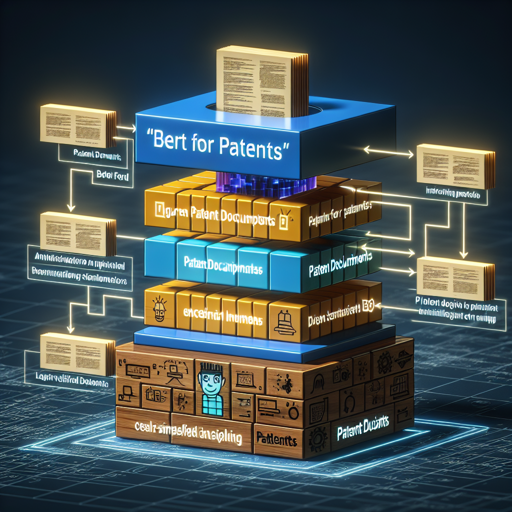
In the realm of artificial intelligence and machine learning, BERT for Patents emerges as a cutting-edge model to revolutionize the patent analysis landscape. Trained on over 100 million patents globally, this powerful version of BERTLARGE is tailored for understanding and contextualizing patents, making it easier to derive insights from this complex legal domain.
Getting Started with BERT for Patents
To deploy the BERT for Patents model, follow these straightforward steps:
- Introduction to BERT: Familiarize yourself with BERT and its underlying architecture. BERT stands for Bidirectional Encoder Representations from Transformers and is well-known for its ability to grasp context in natural language processing tasks.
- Installation: Clone the BERT for Patents repository from GitHub and install the necessary dependencies.
- Model Checkpoints: Download the original TensorFlow checkpoint to start using the model. You can find the details of the checkpoint in the blog post on Google’s AI advancements in patent analysis.
- Running the Model: Follow the instructions laid out in the GitHub repository for running the model with your patent data.
Understanding the Example Inputs
Imagine you are an inventor with a revolutionary concept. To process this efficiently, you feed it into the model using the following example inputs:
The present [MASK] provides a torque sensor that is small and highly rigid and for which high production efficiency is possible.The present invention relates to [MASK] accessories and pertains particularly to a brake light unit for bicycles.The present invention discloses a space-bound-free [MASK] and its coordinate determining circuit for determining a coordinate of a stylus pen.The illuminated [MASK] includes a substantially translucent canopy supported by a plurality of ribs pivotally swingable towards and away from a shaft.To contextualize this, think of the BERT model as a perceptive librarian in a massive library of patents. When you ask the librarian about a specific topic (in this case, a patent’s content), they can filter through countless documents, filling in the gaps where information might be missing (the masked words) based on the context provided by other surrounding documents.
Troubleshooting Common Issues
While utilizing BERT for Patents, you may encounter several setbacks. Here are some troubleshooting tips:
- Model Not Loading: Ensure that the TensorFlow checkpoint has been correctly downloaded and that all file paths are accurately referenced in your code.
- Unexpected Outputs: Check your data format and ensure that it matches the model’s expected input format for optimal results.
- Performance Issues: If the model runs slowly, verify the specifications of your hardware. More RAM and an upgraded GPU can significantly enhance processing speed.
For more insights, updates, or to collaborate on AI development projects, stay connected with fxis.ai.
Conclusion
At fxis.ai, we believe that such advancements are crucial for the future of AI, as they enable more comprehensive and effective solutions. Our team is continually exploring new methodologies to push the envelope in artificial intelligence, ensuring that our clients benefit from the latest technological innovations.