
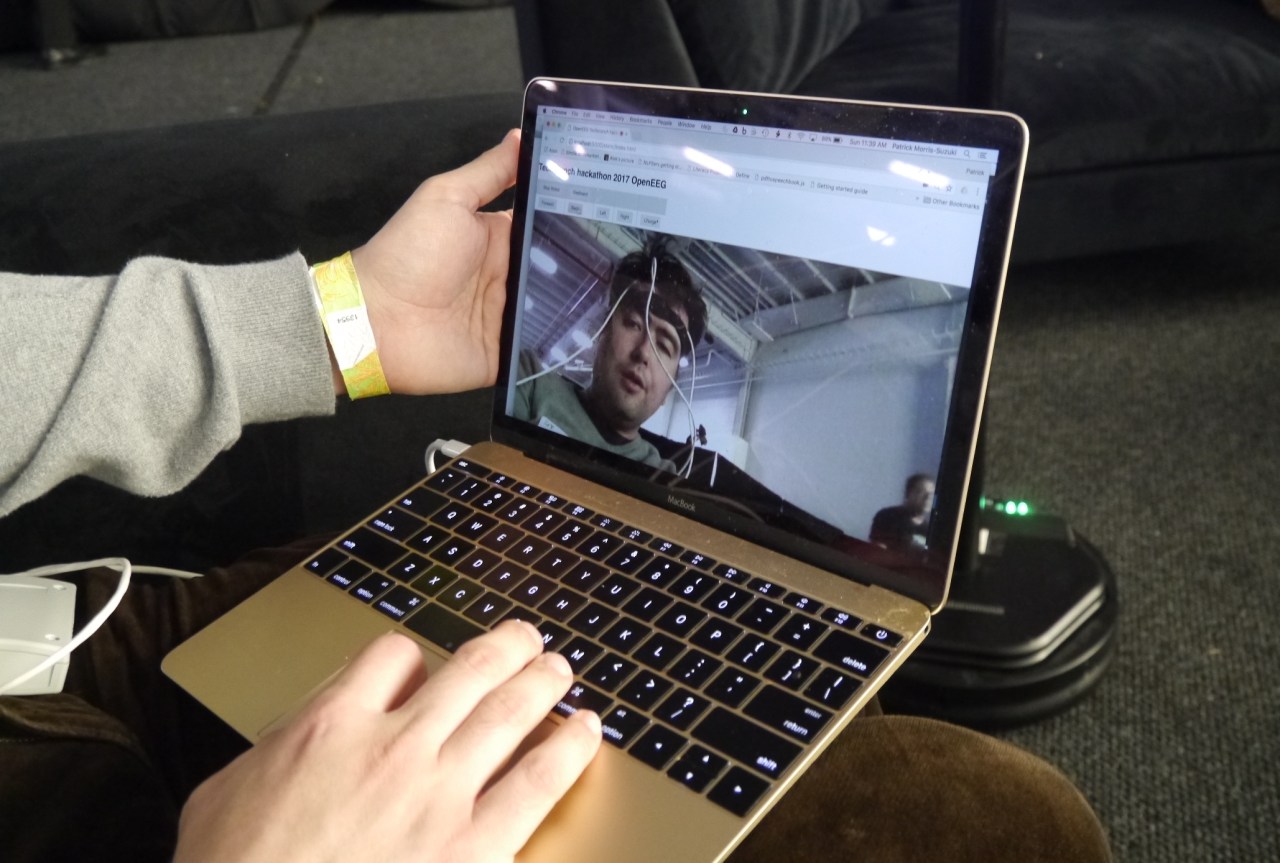
Imagine a world where people with limited mobility can type just by blinking their eyes. This revolutionary idea isn’t as far-fetched as it may seem. At the TechCrunch Disrupt New York 2017, software developer Patrick Morris-Suzuki embarked on a fascinating challenge: to create a blink-detecting system for hands-free typing using an open EEG device. Drawing inspiration from Facebook’s pioneering work on brain-computer interfaces, Morris-Suzuki aimed to develop a low-cost, user-friendly wearable that could transform lives. Let’s delve into this remarkable project and the innovative techniques that powered it.
The Vision Behind the Hack
As technology advances, assistive devices for individuals with disabilities continue to evolve. Morris-Suzuki’s goal was to create a solution for persons with limited manual mobility, such as those suffering from ALS, to enable seamless communication. The reliance on eye blinks as a method of control is intuitive, yet complicated when it comes to translating those signals into functional commands.
How the System Works
Utilizing a $100 open EEG-SMT (electroencephalogram) device produced by Olimex, Morris-Suzuki constructed a headset fitted with electrodes. The basic premise? Employ blinks as selector signals to navigate an on-screen keyboard. This reduced the number of actions required to communicate effectively. However, accomplishing this wasn’t without its challenges.
Predictive Text: The Game Changer
One of the standout features of this system was its predictive text capability. By leveraging an open-source random text generator and training a recurrent neural network, Morris-Suzuki was able to create a user-friendly digital keyboard. With only 12 keys displayed in an HTML layout, the input process became streamlined, minimizing the number of required blinks to form words.
Real-World Applications
The application of this technology can be life-changing. Consider renowned physicist Stephen Hawking, who famously relied on cheek movements to communicate through adaptive technology. The innovation brought forth by Morris-Suzuki has considerable potential to enhance the independence of individuals with severe mobility limitations, allowing them to connect and express themselves more fully.
Technical Hurdles
Despite the potential of such a system, the journey was fraught with obstacles. One of the main challenges was the noise associated with signals captured through the EEG device. Morris-Suzuki noted that while blinks should theoretically offer reliable signals, environmental factors and equipment limitations often compromised accuracy. His backstage demonstrations confirmed this, highlighting how difficult it can be to achieve stability during a live presentation.
Bridging Human-Machine Interaction
- Integration of Telepresence Robots: Beyond just typing, Morris-Suzuki envisioned allowing users to “blink-drive” robots, giving them a sense of physical presence and control over their environment.
- Cloud-Based Communication: The ability to communicate in real-time was made possible through the use of APIs like Firebase, signifying a move towards cloud-dependent architectures for assistive technologies.
Looking Ahead
As with many tech innovations, the path to refinement is ongoing. While high-end EEG devices boast confidence levels upward of 90% in controlled settings, Morris-Suzuki’s experience illustrated the disparity between regulated environments and unpredictable live demonstrations.
Ultimately, this project underscores the essence of creativity and experimentation inherent in hackathons. By addressing practical challenges through innovative technological avenues, Morris-Suzuki and others are paving the way for more inclusive solutions in assistive tech.
Conclusion
Patrick Morris-Suzuki’s journey highlights the intersection of technology and empathy. As advancements in artificial intelligence and human-computer interfaces continue to emerge, it becomes ever more critical to place user needs at the forefront. With collaborative efforts and continued exploration, we can expect great strides toward making communication accessible to everyone.
For more insights, updates, or to collaborate on AI development projects, stay connected with fxis.ai. At fxis.ai, we believe that such advancements are crucial for the future of AI, as they enable more comprehensive and effective solutions. Our team is continually exploring new methodologies to push the envelope in artificial intelligence, ensuring that our clients benefit from the latest technological innovations.