
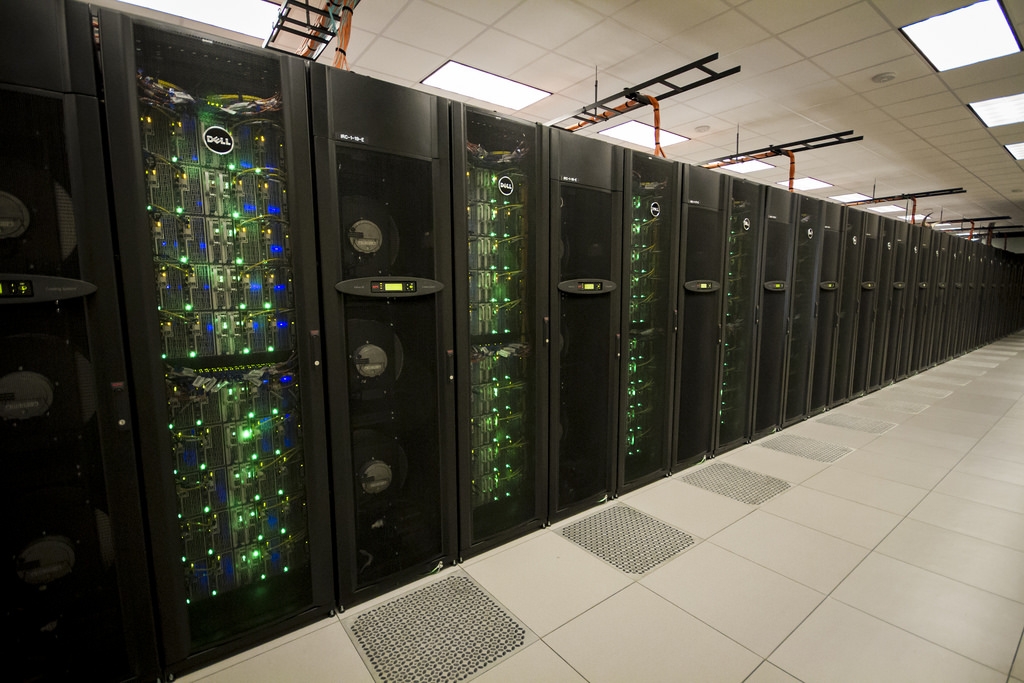
As we find ourselves entrenched in an era where data reigns supreme, the demand for high-performance computing continues to surge. In this landscape, a new heavyweight contender is about to enter the ring — the $30 million Stampede 2 supercomputer, boasting an impressive 18 petaflops of peak processing power. This formidable system promises to revolutionize the way researchers tackle some of the most complex problems facing our world today.
The Design and Capabilities of Stampede 2
With its staggering processing capacity, Stampede 2 is engineered to perform at the very edge of computational innovation. Positioned alongside established giants like Cray’s Titan and IBM’s Sequoia, this supercomputing marvel stands ready to support an array of research disciplines, from elemental physics to climate modeling.
The original Stampede, which launched in March 2013, already made headlines with its robust performance. However, Stampede 2 approximately doubles its predecessor’s capabilities, thanks to an updated architecture utilizing the 14nm Xeon Phi chips, known as “Knights Landing.” These advanced processors feature an increased core count—72 cores compared to the original 61—ensuring enhanced computational efficiency and speed.
Unleashing Advanced Data Processing
Stampede 2’s design goes beyond mere numbers on paper. It integrates cutting-edge features including:
- High-Speed Data Transfer: Capable of shifting up to 100 gigabits per second, ensuring smooth data flow for intense computational tasks.
- Advanced RAM and Storage: With an enhanced DDR4 RAM that functions not only as regular memory but also as a massive third-level cache, data management becomes seamless.
- 3D Xpoint Non-Volatile Memory: A groundbreaking storage technology that outperforms traditional NAND memory while being more affordable than DRAM.
These developments mean researchers can process and analyze datasets that were previously impractical due to the time constraints involved in computation. For instance, envision simulating the behaviors of countless particles in complex systems like colloidal gels or astronomical phenomena.
Broader Impacts Across Disciplines
The implications of Stampede 2 stretch far beyond its initial technological prowess. According to Dan Stanzione, the director of the Texas Advanced Computing Center, systems like Stampede are integral to driving innovation across research domains. The history of the original Stampede speaks to this potential; projects ranged from earthquake risk assessment to massive proofs in mathematics, showing how supercomputing capabilities can influence policy and advance scientific knowledge.
With a steadily growing number of institutions and users taking advantage of such resources, the need for enhanced computational power is unlikely to diminish. The last decade alone has seen a remarkable increase in the active user base, illustrating an ever-pressing demand for these modern scientific tools.
Challenges Ahead and the Need for Speed
While excitement builds around Stampede 2, challenges remain. Questions linger regarding the timeline for its operational launch, with many speculating it may take upwards of a year or more for the system to be fully functional. During this wait, the competitive landscape of supercomputing may continue to evolve, pushing researchers to seek out new resources and capabilities.
Conclusion
As we stand on the brink of a new era in supercomputing with Stampede 2, the possibilities for research and innovation are vast. It is a paradigm shift that aligns seamlessly with the growing demands of data-driven discovery. At fxis.ai, we believe that such advancements are crucial for the future of AI, as they enable more comprehensive and effective solutions. Our team is continually exploring new methodologies to push the envelope in artificial intelligence, ensuring that our clients benefit from the latest technological innovations.
For more insights, updates, or to collaborate on AI development projects, stay connected with fxis.ai.