
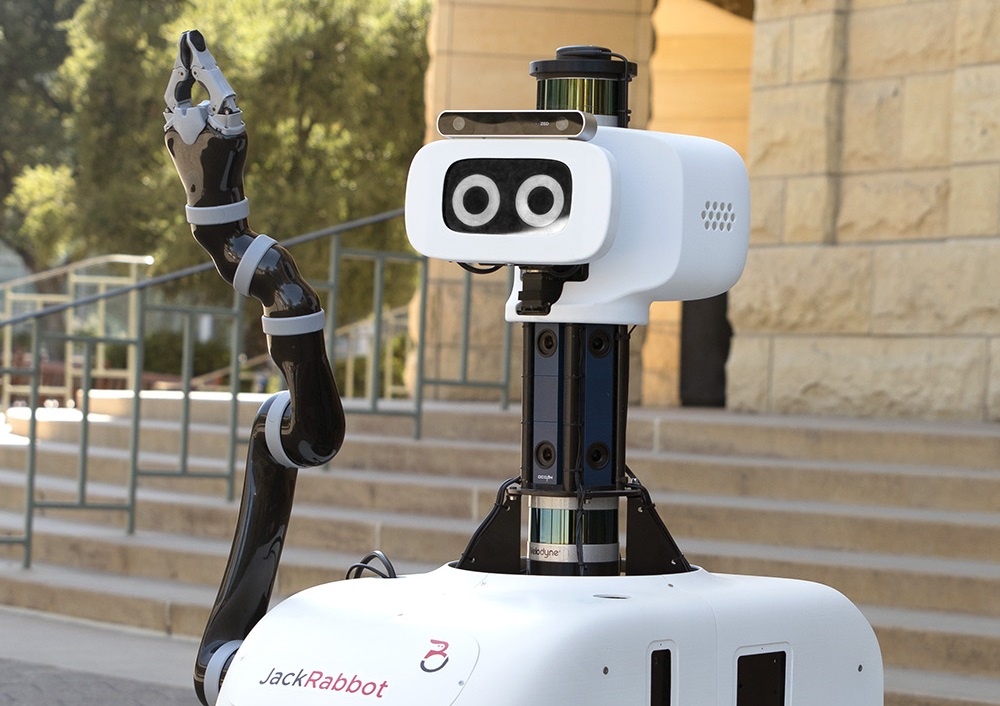
As urban landscapes continue to evolve with the advent of smart technologies, autonomous robots are stepping into our daily environments, making monumental progress in understanding human social cues. One such innovative project creating waves in the robotics community is Stanford’s Jackrabbot 2. Originally conceived to tackle the intricacies of urban navigation, this advanced robot is now honing its skills in polite human interaction while maneuvering crowded spaces.
The Importance of Politeness in Robotics
Autonomous robots are often faced with the challenge of navigating through bustling areas while ensuring they do not disrupt the flow of human traffic. Stanford researchers are keenly aware that mere pathfinding isn’t enough—robots must also understand the nuances of human behavior. As grad student Ashwini Pokle noted, humans unconsciously maintain personal distances and adapt their movements based on social interactions. Recognizing these subtleties is critical for robots like Jackrabbot 2, which aims to enhance safety and user experience in public settings.
Learning Through Experience: The Evolution of Jackrabbot
The journey of Jackrabbot began in 2016, where it was tasked with learning how college students navigate the Stanford campus. This initial iteration laid the groundwork by developing a model of human movement and space utilization. However, rapid advancements in technology prompted a redesign, leading to the creation of Jackrabbot 2. Equipped with significantly enhanced sensors, including dual Velodyne lidar units and stereo cameras, this new robot offers a comprehensive 360-degree awareness of its surroundings.
Technological Advancements: An Upgrade for Precision
Jackrabbot 2 stands as a testament to modern engineering, housing powerful GPUs that allow it to process real-time data with unparalleled precision. This advanced sensor suite not only improves its capabilities to detect human motion but also ensures a higher level of safety in navigation. The research team believes that by integrating images captured from this upgraded system, they can refine their existing movement models and enhance overall functionality.
Human Interaction: Gesturing Towards Clarity
In addition to superior navigation capabilities, the addition of a human-like arm enables Jackrabbot 2 to communicate non-verbally. Just as we use gestures to indicate our path or signal intent, the robot can wave a hand to create clarity in uncertain situations, whether it is deciding who gets to enter a doorway first or navigating crowded sidewalks. This gesture-based communication is anticipated to ease interactions between robots and humans, thus fostering a more seamless coexistence.
Applications in the Real World
The potential applications for Jackrabbot and similar delivery robots are extensive, particularly in the realm of last-mile logistics. As companies like Kiwi, Starship, and Marble venture into the realm of robotic delivery, understanding how to navigate safely around pedestrians is paramount. The last thing these companies need is a delivery robot colliding with a customer, which would undoubtedly deter future orders.
Looking Ahead: The Future of Robotic Navigation
As Jackrabbot 2 continues to roam the Stanford campus and gather data about human interactions, it sets the stage for a future where robots can autonomously navigate crowded environments with the same social etiquette as humans. The journey of teaching a robot to be polite mirrors our own experiences in navigating social norms, promising a synergy between technology and human interaction that could redefine robotics in public spaces.
Conclusion
In summary, Jackrabbot 2 is not merely a machine; it’s a learning entity that embodies the evolving relationship between technology and society. Its advancement underscores the importance of understanding social cues in automation, ultimately leading to more responsive robots in our daily lives. At fxis.ai, we believe that such advancements are crucial for the future of AI, as they enable more comprehensive and effective solutions. Our team is continually exploring new methodologies to push the envelope in artificial intelligence, ensuring that our clients benefit from the latest technological innovations. For more insights, updates, or to collaborate on AI development projects, stay connected with fxis.ai.