
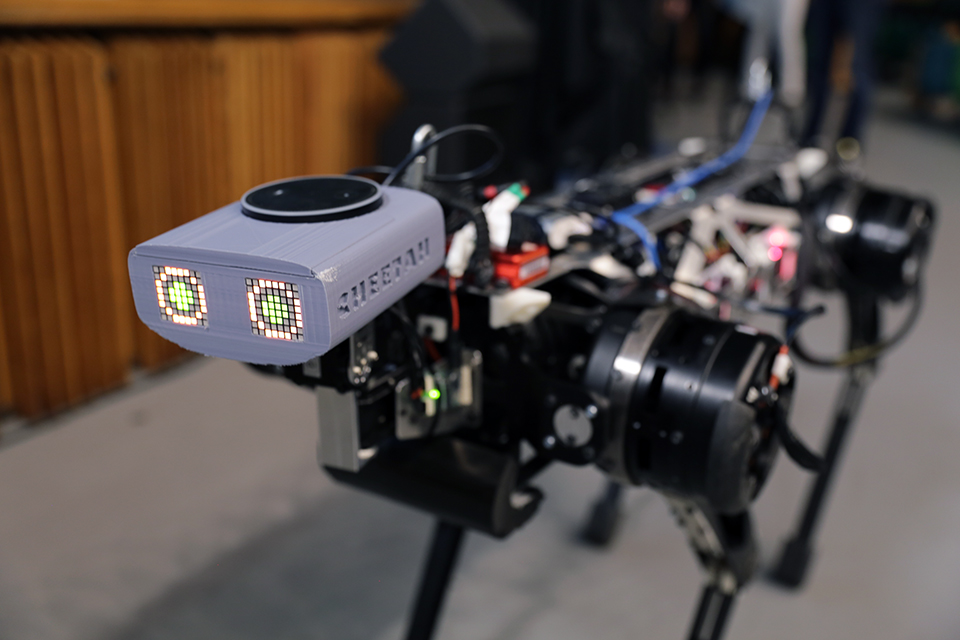
In the rapidly evolving landscape of robotics, the spotlight is now firmly on MIT’s latest innovation: the Cheetah 3 robot. Unveiled at TC Sessions: Robotics in Cambridge, Massachusetts, this four-legged marvel embodies a significant shift in robotic engineering, moving beyond impressive speed and agility demonstrations to practical applications that can save lives. With its enhanced capabilities and focus on search and rescue operations, Cheetah 3 is poised to make a meaningful impact in emergency situations where human intervention is risky or impossible.
Getting Beyond the Showroom
While earlier iterations of the Cheetah were celebrated for their impressive performance—sprinting at speeds of up to 14 miles per hour and autonomously overcoming obstacles—the latest version reflects a deeper understanding of robotics’ potential in the real world. Professor Sang-bae Kim, the project lead, articulated a vision that extends beyond showcasing technology: “We want to use this in a place where we don’t want to use humans.” The Cheetah 3 is intended to play a crucial role in scenarios such as disaster response, where it can safely gather data from environments deemed too hazardous for human rescuers.
Rugged Terrain? No Problem!
Thanks to its animal-inspired design, the Cheetah 3 can traverse terrain that traditional wheeled robots simply cannot navigate. Shedding light on this, Kim noted, “We’ve conquered air, water, ground in a different way. We modified the ground for our wheels.” The Cheetah’s four-legged structure allows it to step over rubble, climb stairs, and maintain balance even on three legs. The ingenious design draws on nature’s evolutionary blueprint, suggesting that a robot emulating animal movement might adapt more effectively to its surroundings.
Aiming for Real-world Applications
- Search and Rescue Missions: Cheetah 3 can assess environments post-disaster, such as Fukushima, where human lives are at risk.
- Environmental Monitoring: Equipped to perform routine checks in various emergency contexts, it can monitor conditions without endangering human life.
- Payload Capacity: Enhanced design means it can carry equipment, potentially aiding in complex rescue scenarios.
The Path Ahead: Challenges and Innovations
Despite its advanced capabilities, it’s important to recognize that Cheetah 3 is still in the early stages of development. The team at MIT is earnestly focused on iterative testing, deploying the robot across the MIT campus to assess its performance on various terrains. Kim humorously remarked, “We’re doing the easy things first,” a testament to their commitment to getting foundational features right before taking on more complex tasks.
Next, the team is working on adding dexterous hands that could perform sophisticated functions, from grasping objects to opening doors—an exciting prospect for enhancing the robot’s functionality in real-world rescue missions.
The Bigger Picture
The development of Cheetah 3 reflects a growing trend in robotics: the shift towards functional, life-saving applications rather than simply entertainment or exhibition. As robots gain the ability to navigate the unpredictable terrains of disaster zones, their influence on emergency response will undoubtedly expand. Collaborations, like those seen with Boston Dynamics’ similar pursuits, highlight the importance of shared knowledge in advancing these technologies. Though differing in design philosophy—Cheetah 3 favors electric motors over hydraulics—the mutual goal remains the same: to refine robotic functionality and maximize their utility in critical situations.
Conclusion: A Leap Towards Safety and Efficiency
The Cheetah 3 robot signifies much more than a new engineering achievement; it represents humanity’s proactive approach to solving real challenges in difficult environments. As it continues to undergo rigorous testing and optimization, its potential for transforming search and rescue operations becomes increasingly clear. By bridging the gap between technological capability and practical application, MIT is paving the way for future innovations that can contribute significantly to community safety in disaster scenarios.
At fxis.ai, we believe that such advancements are crucial for the future of AI, as they enable more comprehensive and effective solutions. Our team is continually exploring new methodologies to push the envelope in artificial intelligence, ensuring that our clients benefit from the latest technological innovations.
For more insights, updates, or to collaborate on AI development projects, stay connected with fxis.ai.