
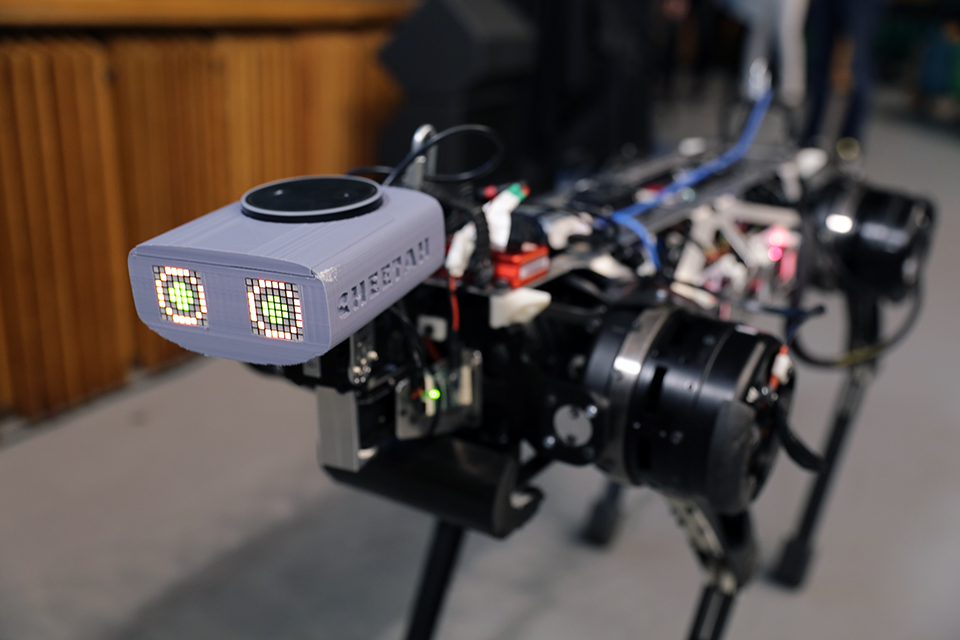
In a world increasingly reliant on technology, the advances we make in robotics are shaping our understanding of autonomous movement and its applications. One such innovation is MIT’s Cheetah 3, a remarkable robotic system designed to navigate challenging terrains, including debris-littered stairs, without the reliance on visual sensors. With its latest demonstration set to take place at the International Conference on Intelligent Robots in Madrid, we dive into what makes this robot a game-changer in the field of robotics, particularly for search and rescue missions.
The Art of Blind Locomotion
At the heart of Cheetah 3’s impressive capabilities is what is known as “blind locomotion.” Unlike its predecessors, Cheetah 3 has been programmed to ascend stairs while relying solely on tactile feedback rather than visual inputs. This innovative approach is designed for the unpredictable environments in which rescue robots must operate. Associate Professor Sangbae Kim emphasizes the importance of a robot that can handle unexpected obstacles without being heavily dependent on sight.
- Why Go Blind?
Visual data can be inconsistent and unreliable in chaotic environments, creating a lag in real-time responses. By leveraging tactile sensing, the Cheetah can achieve faster movements and maintain balance effectively during its ascent. The abandonment of visual data allows the robot to engage in rapid movement while managing quick adjustments as obstacles arise.
Advanced Algorithms at Work
One of the highlights of Cheetah 3 is its utilization of two cutting-edge algorithms: contact detection and model-predictive control. These algorithms empower the robot to maintain stability and recover from potentially destabilizing circumstances, such as slipping on uncertain surfaces. This adaptability is crucial for the robot’s operational role in disaster-relief scenarios.
- The Dance of Coordination
- Speed Is Key
With contact detection, Cheetah 3 can determine the optimal positioning of its legs in real-time, allowing for a more fluid climbing motion. This dynamic movement capability not only permits better balance but also enhances the robot’s ability to navigate complex terrains.
With the capacity to run at speeds of up to 14 miles per hour, the Cheetah 3 is designed not just for stability but for speed—an important feature when time is a critical factor during rescue missions.
Lessons from Real-Life Applications
The ultimate vision for Cheetah 3 transcends mere technology. It encapsulates the philosophical aspiration to utilize robotic aids in situations where human entry is either dangerous or impossible. The thorough testing of Cheetah on various terrains, including stairways filled with wood debris, serves as a testament to its potential in real-world applications.
Conclusion: The Vanguard of Robotic Development
The innovation embodied in MIT’s Cheetah 3 is a significant step toward making search and rescue operations safer and more efficient. By removing visual sensors and relying on tactile feedback, this robot showcases not only technological advancement but also a profound understanding of the environments it is designed to navigate. As we look ahead, the capabilities of Cheetah 3 may offer a glimpse into a future where autonomous machines play an integral role in emergency situations, enhancing our ability to respond to crises effectively.
For more insights, updates, or to collaborate on AI development projects, stay connected with fxis.ai.
At fxis.ai, we believe that such advancements are crucial for the future of AI, as they enable more comprehensive and effective solutions. Our team is continually exploring new methodologies to push the envelope in artificial intelligence, ensuring that our clients benefit from the latest technological innovations.