
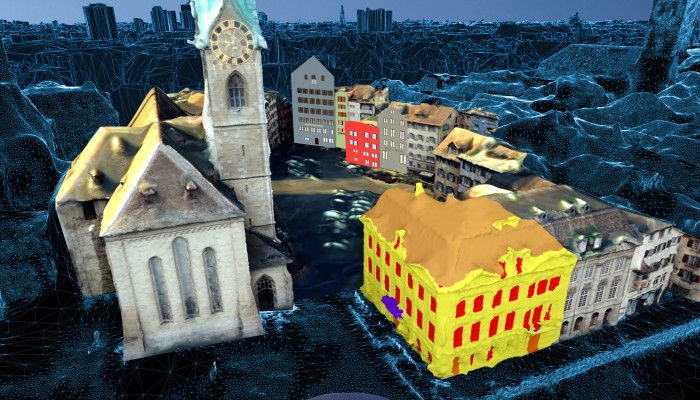
In a world where technology continues to redefine our daily experiences, the sphere of urban mapping is witnessing a significant transformation. The VarCity project in Zurich, Switzerland, is a pioneering initiative that harnesses the power of crowdsourced images from social media, webcams, and other online platforms to recreate cities in stunning 3D. This innovative approach is not just an evolution of existing mapping technologies but a reflection of the growing importance of data-driven solutions in urban planning and smart city development.
The Core Concept Behind VarCity
At its core, VarCity operates on a simple yet powerful premise: there is an abundance of visual data available related to urban environments. By collecting images and videos captured by individuals and technology alike, the project has developed a comprehensive 3D model of Zurich that reveals much more than just a static representation of streets and buildings.
- Data Sourcing: VarCity taps into an expansive range of sources including social media, transit cameras, and aerial photography. This creates a trove of data that is constantly expanding as people interact with their cities.
- Rich Data Insights: Unlike traditional mapping tools that rely on static images, VarCity uses dynamic datasets that illustrate real-time activities. For instance, analysis of traffic patterns or pedestrian flow can inform urban planners and traffic authorities about high-congestion areas.
- Precision Modeling: The algorithms developed by ETH Zurich’s Computer Vision Lab enable the differentiation between various surfaces, including sidewalks versus roads and grass versus pavement. This level of detail adds layers of richness to the resulting 3D models.
Applications of VarCity Data
The potential applications arising from VarCity’s data are extensive and varied. Several startups have already been forged from this initiative, showcasing practical ways in which this 3D urban mapping can be leveraged:
- Spectando & Casalva: These startups focus on conducting virtual inspections of buildings, highlighting issues such as structural damage without needing physical access.
- Parquery: This innovative solution is designed to monitor parking spaces in real-time, offering insights that can significantly enhance urban mobility and reduce congestion.
- UniqFEED: This company utilizes VarCity’s insights to monitor sports broadcasts, providing advertisers with analytics regarding visibility and engagement in real-time.
Future Prospects and Technological Evolution
The VarCity project is continually evolving, and its future looks promising. With the volume of available image data expected to increase dramatically over the coming years, the algorithms developed have the potential to create even more precise and comprehensive 3D urban mappings.
As Kenneth Vanhoey, one of the postdoctoral researchers involved in the project, stated, “The aim of our project was to develop the algorithms for such 3D city models, assuming that the volume of available images and videos will also increase dramatically in the years ahead.” By effectively using this wealth of information, cities can become smarter and more efficient, ultimately enhancing the quality of urban life.
Conclusion
The VarCity project exemplifies how technology can transform our understanding and interaction with urban environments. By leveraging crowdsourced images and sophisticated algorithms, it not only creates accurate 3D models but also provides invaluable insights that can aid in urban planning and management.
At fxis.ai, we believe that such advancements are crucial for the future of AI, as they enable more comprehensive and effective solutions. Our team is continually exploring new methodologies to push the envelope in artificial intelligence, ensuring that our clients benefit from the latest technological innovations. For more insights, updates, or to collaborate on AI development projects, stay connected with fxis.ai.