
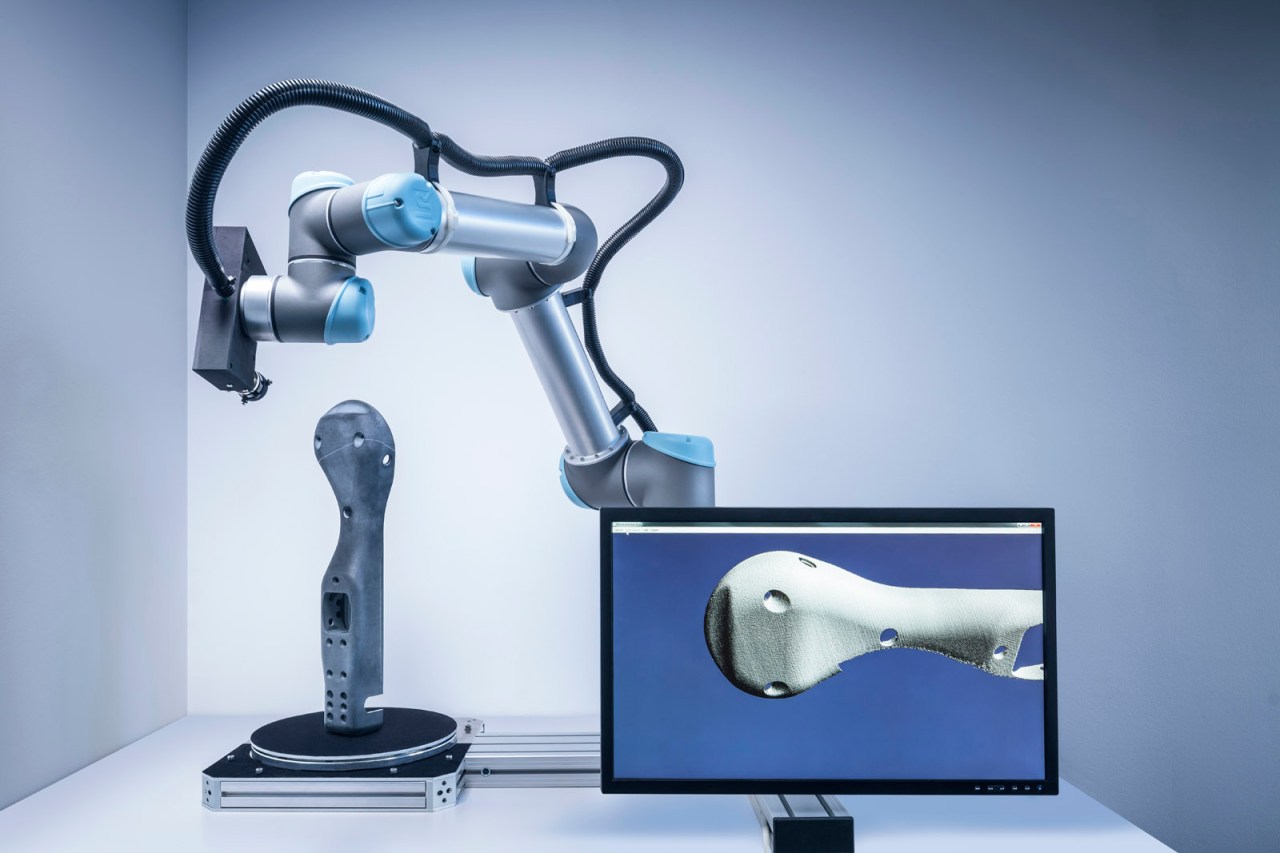
The world of 3D scanning has long been a blend of artistry and engineering, where precision meets creativity. Traditionally, users would employ various methods to create a digital reproduction of physical objects, often relying on scanners that methodically circled an item, collecting data but not necessarily maximizing efficiency. The introduction of an autonomous 3D scanner by the Fraunhofer Institute marks a leap forward, as it involves an intelligent scanning process that not only captures but also evaluates and adapts in real time.
Breaking Away from Conventional Techniques
Typical 3D scanners operate on a basic level, rotating around an object and compiling data to construct a mesh. While this basic functionality suffices for many applications, it often leads to flaws and oversights due to inherent limitations. The new technology engineered by Fraunhofer, led by Pedro Santos at the Institute for Computer Graphics Research, elevates this experience by allowing the scanner to independently assess what it sees, determining the best angles and movements required for a comprehensive scan.
The Mechanics Behind Self-Learning Scanning
What sets this scanner apart is its capability to plan and adjust its scanning strategy on-the-go. This means that if certain areas of an object are initially scanned poorly—due to occlusions or complex geometries—the scanner can recalibrate itself in real-time, ensuring that those areas are captured accurately without requiring user intervention. The system intelligently learns its environment, eliminating the tedious back-and-forth often associated with traditional scanning techniques.
Applications and Real-World Benefits
This advanced scanner opens up a plethora of possibilities across various industries.
- Custom Manufacturing: Whether you’re crafting a unique lamp or forging parts for vintage cars, this 3D scanner can replicate components that it hasn’t previously encountered.
- Efficient Prototyping: Rapid prototyping becomes significantly streamlined as the scanner accurately duplicates intricate designs without the necessity of pre-loaded 3D models.
- Historical Preservation: This technology could play a crucial role in preserving artifacts and objects whose shapes and details need meticulous attention.
Looking Ahead: The Future of 3D Scanning
The implications of a scanner that adapts and learns in real-time are profound. For professionals in production, art, and restoration, this means no longer being bound by the limitations of pre-defined parameters or having to re-scan items due to errors. In effect, the scanner transforms from a passive tool into a dynamic problem-solver, capable of producing accurate representations of objects with minimal user input.
Experience the Innovation
For those interested in exploring this cutting-edge technology, a chance to see it in action will occur at Hannover Messe in April. This event serves as a platform for showcasing how such innovations can redefine industry standards and practices.
Conclusion
As we continue to tread further into an era where artificial intelligence intersects with everyday tools, autonomous 3D scanning represents just the beginning of what we can achieve. The advancements made by the Fraunhofer team exemplify how intelligent machines can simplify processes and enhance productivity across countless fields. At fxis.ai, we believe that such advancements are crucial for the future of AI, as they enable more comprehensive and effective solutions. Our team is continually exploring new methodologies to push the envelope in artificial intelligence, ensuring that our clients benefit from the latest technological innovations.
For more insights, updates, or to collaborate on AI development projects, stay connected with fxis.ai.