
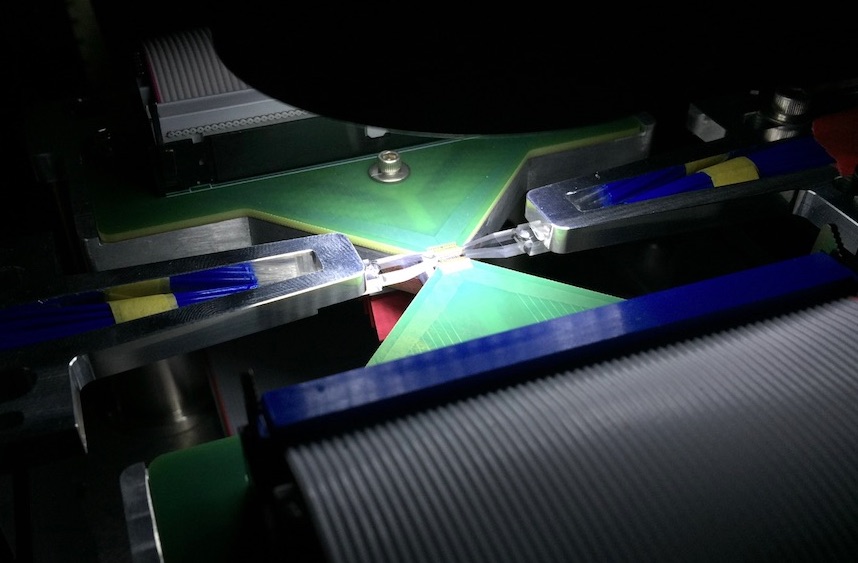
Artificial Intelligence (AI) is transforming industries, from enhancing voice recognition systems to generating personalized playlists. However, the rapid demands of AI functionalities often overwhelm traditional computing architectures. Enter Lightmatter, a pioneering startup that promises to reshape AI computation through the fascinating world of photonic computing. By employing light rather than electrical signals, this groundbreaking technology could ignite a new era in AI processing.
Understanding Photonic Computing
At its core, photonic computing utilizes photons (light particles) to perform calculations at unprecedented speeds, vastly outpacing conventional silicon-based chips. This revolutionary approach allows for near-instantaneous data processing and drastically reduces energy consumption. Lightmatter’s CEO, Nick Harris, is not just a visionary; he has academic credibility, having published extensively on this subject during his tenure at MIT. His research provides the foundation upon which Lightmatter builds its innovative technology.
The Challenge of AI Computation
The matrix-vector multiplication, a common operation in AI applications, showcases the limitations of traditional computing. As AI systems surge in complexity and demand, the processing requirements threaten to outstrip existing hardware capabilities, creating a bottleneck. Harris points out, “A lot of deep learning relies on this specific operation that our chip can accelerate.” This revelation indicates that advancing AI could rely heavily on evolving our computational paradigms.
Breaking the Computational Barrier
Just consider what Lightmatter offers: instead of breaking down problems into smaller operations managed by transistors and outdated architectures, its photonic chips handle entire calculations simultaneously. This innovation stems from the ability to direct beams of light through customizable lenses and sensors, effectively turning light into a computational medium. Such capability not only accelerates response times but significantly enhances efficiency.
- Speed: Light travels faster than electricity, allowing computations to occur almost instantaneously.
- Energy Efficiency: Photonic chips consume substantially less power than traditional chips, making them eco-friendlier options.
- Scalability: With designs already in place for chips boasting hundreds of computational units, the future looks bright for larger and more robust systems.
The Future of AI Technology
With the successful completion of an $11 million Series A funding round, Lightmatter stands poised to transition from promising prototypes to full-fledged products. This injection of capital will bear dividends in terms of talent acquisition and development—hallmarks of a company ready to penetrate advanced AI sectors. Industry experts, such as investors from Matrix and Spark, underscore the uniqueness of Lightmatter’s approach: “This is the first application of optical computing in a controlled manner.”
Unlike conventional players who optimize traditional chips, Lightmatter’s foray into photonics renders its technology fundamentally distinct. As traditional computing options saturate, Lightmatter represents a paradigm shift capable of meeting the evolving needs of AI.
Real-World Applications and Industry Implications
While you might not see a photonic chip on your desk anytime soon, its implementations in specialized AI hardware will likely become prominent. Imagine tech giants like Google harnessing these chips to train artificial intelligence models more efficiently or deploying them in data centers for rapid machine learning tasks. This yet-to-full impact could redefine how AI tasks are managed, pushing the limits of what’s possible.
Conclusion: A New Dawn for AI
Photonic technology not only addresses the growing demands of AI but also signals a revolution in how we envision computing architectures. As the industry stands at a crossroads, the advancements by companies like Lightmatter promise to drive innovation toward unprecedented heights. At fxis.ai, we believe that such advancements are crucial for the future of AI, as they enable more comprehensive and effective solutions. Our team is continually exploring new methodologies to push the envelope in artificial intelligence, ensuring that our clients benefit from the latest technological innovations.
For more insights, updates, or to collaborate on AI development projects, stay connected with fxis.ai.