
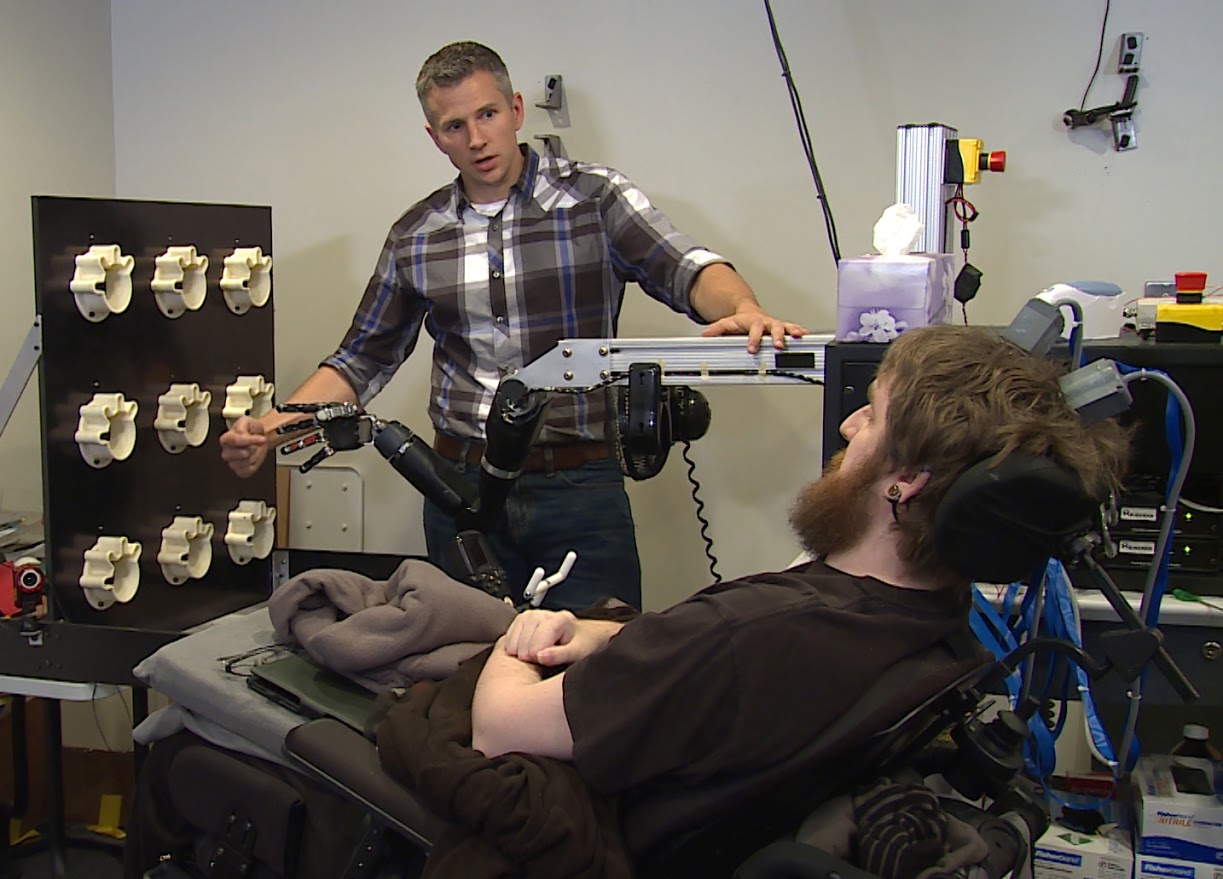
Sensory feedback is essential for our daily interactions with the world. For those who have endured the loss of sensation due to spinal injuries, such feedback may seem like a distant dream. However, groundbreaking research at the University of Pittsburgh is challenging that notion by connecting a human brain to a robotic hand, paving the way for a future where individuals can “feel” through prosthetics. This could change the narrative surrounding disabilities and redefine the possibilities for those who have lost the ability to sense their environment.
A Leap into Sensation
In a remarkable proof-of-principle experiment, Nathan Copeland, a quadriplegic man whose spinal injury severed his neural connections, experienced the sensation of touch through a robotic hand. This feat wasn’t merely a passive observation but involved active participation from Copeland, demonstrating his remarkable mental adaptation. The researchers prompted him to identify which of the robotic fingers was being touched, showcasing astonishing accuracy—initially at 85% right, eventually nearing 100%.
The Science Behind the Breakthrough
The project, spearheaded by Robert Gaunt and his team, takes an innovative approach by directly linking the robotic hand to the brain instead of relying on the broken peripheral nervous system; this distinction is crucial. Here’s how it works:
- The researchers implanted microelectrode arrays into the sensory cortex of Copeland’s brain, targeting the regions associated with tactile sensations.
- Over several months, they stimulated these areas to identify specific patterns and locations corresponding to sensations from each finger.
- The result was a sophisticated connection between human cognition and robotic mechanics that, while still in its infancy, offers an exhilarating glimpse into the future of neuroprosthetics.
Challenges and Future Directions
Despite the significant progress, challenges remain in developing this technology further. The sensations provided by the current interface are described as inconsistent; sometimes perceived as electric or pressure-like. This lack of nuanced feedback highlights the crude nature of the current technology when compared to the dexterity of a natural nervous system. Future efforts must concentrate on refining this sensory data to approximate the complexities of human touch.
Another obstacle is the one-way connectivity of the system. Currently, signals are only sent from the robotic hand to the brain without feedback traveling in the opposite direction. As anyone who has ever used a prosthetic limb will tell you, the ability to control a device intuitively requires not just sensory feedback but also a responsive motor capability. Ongoing explorations in this area will expand the horizon of what’s possible for both mobility and sensation.
The Bigger Picture
This groundbreaking research represents a beacon of hope for many living with paralysis. By directly intervening in the brain’s function, scientists are laying the groundwork for future advancements where users can not only operate robotic limbs but also restore a semblance of their natural sensory experiences. Such innovations may significantly improve the quality of life for users, enhancing independence and interaction with their environment.
The work, documented in the Science Translational Medicine journal, benefits from extensive support from organizations like DARPA and the US Department of Veterans Affairs, affirming its importance and potential impact on medical technology.
Conclusion
The journey of creating a fully functional brain-computer interface that feels and responds like a natural limb may still be long, but recent advancements provide an inspiring look at what’s possible. With dedicated research, the dream of restoring touch for those who have suffered spinal injuries could soon transition from lab bench to reality.
At fxis.ai, we believe that such advancements are crucial for the future of AI, as they enable more comprehensive and effective solutions. Our team is continually exploring new methodologies to push the envelope in artificial intelligence, ensuring that our clients benefit from the latest technological innovations. For more insights, updates, or to collaborate on AI development projects, stay connected with fxis.ai.