
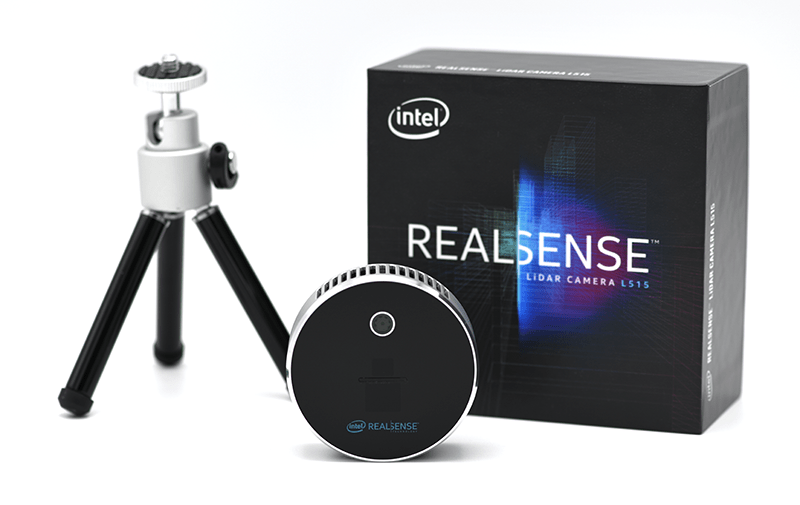
As we navigate through an era where automation and advanced technology are redefining industries, Intel has unveiled a game-changing addition to its RealSense product line — the L515 lidar camera. Designed specifically for warehouse logistics, this compact device showcases how modern technology can streamline operations and boost efficiency in one of the world’s most crucial sectors of trade.
Compact Yet Powerful: Unpacking the L515
The Intel RealSense L515 isn’t just another gadget; it embodies innovation packed into a small, tennis ball-sized unit. It demonstrates that size does not dictate capability. This impressive lidar camera is engineered for a myriad of applications beyond warehouse logistics, including retail, healthcare, 3D scanning, and robotics. The camera transforms scenes into detailed point clouds with millions of depth points, making it not only efficient but accurate.
- High Precision: Operating effectively within a range of 0.25m to 9m, it captures over 23 million accurate depth pixels per second. The depth resolution stands at an impressive 1024 x 768, ensuring that details are not lost.
- Processing Power: Equipped with an internal vision processor, the L515 minimizes motion blur artifacts and provides quick photon-to-depth latency, affirming its reliability in fast-paced environments.
- Energy Efficient: Consuming less than 3.5 watts of power, the lightweight camera can be easily mounted onto handheld devices, ensuring long-lasting performance without constant recharging.
Transforming Logistics and Beyond
With the L515’s introduction, Intel is not just making strides in warehouse logistics but is also tapping into other highly lucrative sectors. The precision and speed of the L515 open doors to enhanced inventory management, allowing companies to monitor stock levels in real-time. This capability significantly reduces the risk of human error, which is often an Achilles’ heel in traditional inventory processes.
But the potential does not stop there. In retail, the L515 can facilitate immersive shopping experiences; in healthcare, it may assist in patient monitoring systems or facility mapping; while in robotics, it could enhance the guidance systems of autonomous machines. The flexibility of this camera makes it an invaluable asset across various industries.
Why This Matters for the Future of AI
Intel’s push into logistics with advanced sensors like the L515 illustrates the growing intersection between AI technology and real-world applications. As automation continues to permeate various sectors, the necessity for reliable, precise, and efficient technologies becomes paramount. The L515 aligns perfectly with this trend, marrying state-of-the-art technology with the practical needs of industries.
At fxis.ai, we believe that such advancements are crucial for the future of AI, as they enable more comprehensive and effective solutions. Our team is continually exploring new methodologies to push the envelope in artificial intelligence, ensuring that our clients benefit from the latest technological innovations.
Conclusion: A Step into the Future
The introduction of the Intel RealSense L515 lidar camera signifies not just a breakthrough in technology but a reimagining of how logistics and numerous other industries function. By enabling accurate and efficient processes, this new device promises to transform warehousing and inventory management. As businesses increasingly pivot towards automation, technologies like the L515 will be at the forefront of this shift, heralding a future where AI-driven innovations redefine operational benchmarks.
For more insights, updates, or to collaborate on AI development projects, stay connected with fxis.ai.