
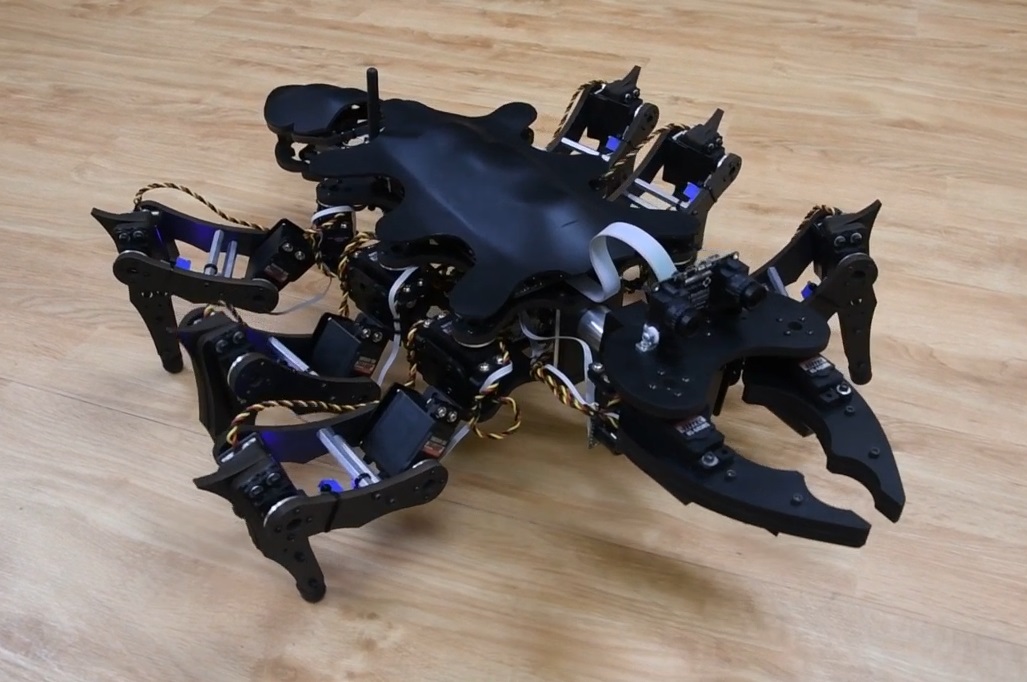
The age of robotics is evolving each day, and stunning innovations are redefining what we perceive as possible. Among the most captivating breakthroughs is the development of ‘robo-bugs’—robotic systems designed to emulate the life-like movements of real insects. While numerous projects attempt to replicate insect locomotion, the challenge often lies in the intricacy of making these robots improvise and adapt like their biological counterparts. A project from Tokyo Tech has made remarkable strides in this domain, demonstrating how robotic systems can walk in ways that they were not explicitly programmed to do.
The Brain Behind the Robo-Bug
The lead researcher, Ludovico Minati, captured the spirit of this extraordinary endeavor, stating, “Perhaps the most exciting moment in the research was when we observed the robot exhibit phenomena and gaits which we neither designed nor expected.” This reaction underscores a critical aspect of the research—the robot’s ability to mirror biological behaviors found in living insects.
Pushing the Boundaries of Robotics
One cannot ignore the complexity often associated with programming an AI to navigate vast scenarios with rapid adaptability. Nevertheless, the simplicity of nature compels researchers like Minati to seek more elegant solutions. The hexapod robot designed by the Tokyo Tech team employs a central pattern generator that streamlines operations. This generator outputs a master signal interpreted by analog arrays, subsequently delivered to oscillators that propel the robot’s legs.
Parameters Overload: The Simplified Approach
One of the critical points of this robotic marvel lies in its ability to condense complexity into a few high-level parameters. These include gait, speed, and posture, which can be adjusted just by tweaking five foundational parameters. Yasaharu Koike, a colleague of Minati, explained, “An important aspect of the controller is that it condenses so much complexity into only a small number of parameters.” This simplification leads to efficient and adaptable locomotion, facilitating easier development of compact robots fit for various terrains.
A Future Beyond Conventional Robotics
The implications of this research reach far beyond academic boundaries. By simplifying the hardware and software requirements for adaptable robots, developers can explore new frontiers in the deployment of these machines in unfamiliar environments. Think search and rescue operations, exploring areas unfit for human access, or even intricate inspections in hazardous locations. The potential applications are vast and could radically transform these sectors.
Embracing the Analog Revolution
What is truly revolutionary about Minati’s work is the push towards more analog solutions instead of the usual reliance on complex programming and circuits. By recognizing that there may indeed be more straightforward, efficient solutions to robust locomotion, we open the door to multi-functional robotic systems that could interact seamlessly with their surroundings in a manner akin to real life.
Conclusion: The Robo-Bug and Our Future
The exploration for creating robots that can navigate complex environments like insects is not just a scientific endeavor; it is a glimpse into the future of robotics. As projects like those led by Tokyo Tech unfold, we inch closer to a world where machines don’t just follow orders but intuitively navigate based on their environments. This innovation paves the way for the next generation of robotic applications, setting a robust foundation for integrating advanced AI in practical, real-world scenarios.
At fxis.ai, we believe that such advancements are crucial for the future of AI, as they enable more comprehensive and effective solutions. Our team is continually exploring new methodologies to push the envelope in artificial intelligence, ensuring that our clients benefit from the latest technological innovations.
For more insights, updates, or to collaborate on AI development projects, stay connected with fxis.ai.