
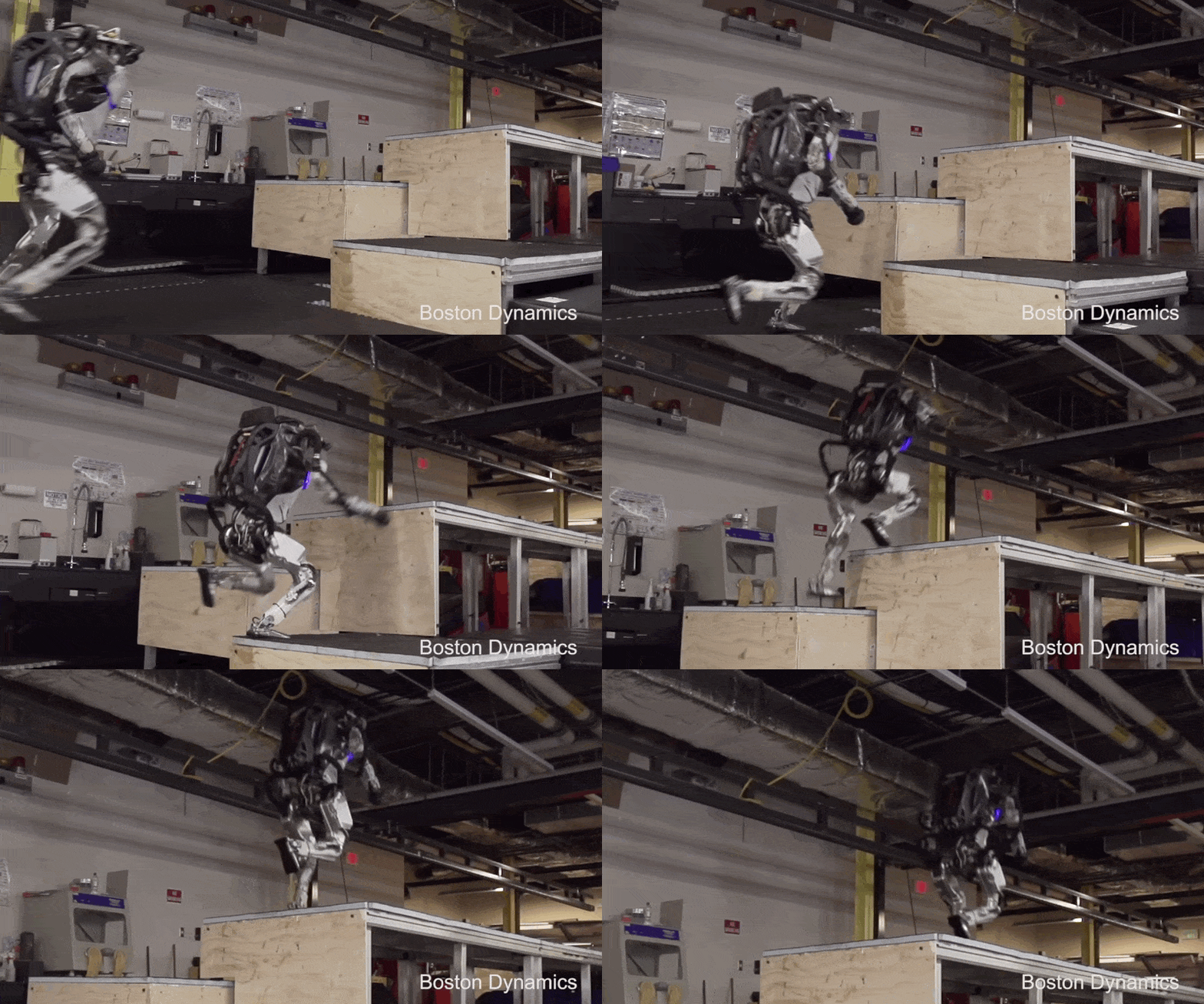
In the ever-evolving world of robotics, Boston Dynamics’ humanoid robot, Atlas, stands out as a remarkable case of rapid technological advancement. While just a few years ago it relied on safety tethers and bolted structures to maintain its balance, Atlas has now graduated to effortlessly jumping over obstacles with the kind of grace and agility that would impress any parkour athlete. Let’s dive deeper into how Atlas has transformed from a clumsy machine into a nimble performer, and what this means for the future of robotics.
The Journey of Atlas: From Safety to Agility
When Boston Dynamics first showcased Atlas, the focus was mainly on its ability to walk on two feet. The technology was groundbreaking yet held back by the fundamental challenges of balance and stability. Fast forward to today—it’s a different story entirely. The latest video demonstration features Atlas making impressive jumps over logs and bounding up a series of 40 cm (1.3 ft) steps.
Understanding the Mechanics Behind the Moves
Achieving this level of agility in a humanoid robot like Atlas involves a complex interaction of mechanics and programming. Here are some of the key factors that contribute to its newfound capabilities:
- Advanced Algorithms: The control systems driving Atlas have evolved to incorporate sophisticated algorithms that manage weight distribution and momentum. This allows Atlas to make split-second decisions regarding its movements.
- Robust Design: Weighing in at approximately 180 lbs, Atlas’s design optimizes its ability to shift its center of gravity efficiently, which is critical for maintaining balance when leaping or bounding.
- Real-time Feedback: The robot is equipped with sensors that provide instant feedback to its control systems, enabling Atlas to adjust its posture mid-leap for effective landings and smooth transitions.
The Implications for Robotics and AI
The progress of Atlas signifies more than just an impressive party trick; it represents the potential of AI and robotics to tackle real-world challenges. The agility displayed by Atlas opens up possibilities for applications in various fields:
- Disaster Response: A robot that can navigate complex terrain could be invaluable in search and rescue missions.
- Construction and Maintenance: Humanoid robots like Atlas could assist in building and maintaining facilities where human workers might face hazards.
- Sports and Entertainment: The agility of Atlas could even lead to novel forms of entertainment or training mechanisms in sports.
Looking Ahead: The Future of Humanoid Robotics
The evolution of Boston Dynamics’ Atlas prompts us to rethink the boundaries of what robots can achieve. With advancements like these, the line between biological and mechanical agility continues to blur. We now stand on the cusp of realizing robots capable of complex interactions with the environment and potentially with humans.
Conclusion
Boston Dynamics has managed to take Atlas from a static marvel of engineering to a dynamic, agile robot capable of impressive feats. The advancements seen today not only highlight the company’s innovative spirit but also serve as a beacon for the entire robotics industry. As we look to the future, one can only imagine the possibilities that await as technology continues to improve.
At fxis.ai, we believe that such advancements are crucial for the future of AI, as they enable more comprehensive and effective solutions. Our team is continually exploring new methodologies to push the envelope in artificial intelligence, ensuring that our clients benefit from the latest technological innovations.
For more insights, updates, or to collaborate on AI development projects, stay connected with fxis.ai.