
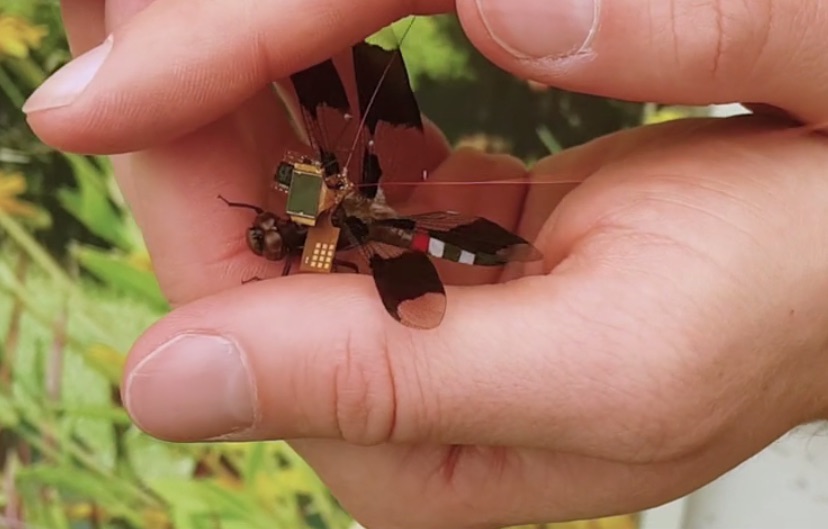
In a world where technological advancements blur the lines between biology and robotics, Draper’s DragonflEye project has taken a monumental leap forward. Imagine a living dragonfly equipped with a sophisticated, solar-powered “mind control” backpack that allows scientists to guide its flight remotely. This groundbreaking endeavor is not merely about flying insects; it represents a new frontier in biobotic innovation, where biology meets technology in extraordinary ways. But how does this all work? Let’s dive deeper into the fascinating world of DragonflEye.
Understanding DragonflEye: The Basics
The DragonflEye initiative seeks to harness the delicate mechanics of dragonfly flight by employing a technique known as optogenetics. This method integrates light-sensitive materials into an insect’s anatomy that can respond to specific wavelengths of light. The goal is to control the insect’s flight patterns in a precise manner, avoiding the clumsy manipulation often associated with artificial flight systems.
The Evolution of the Project
Launched in January, the DragonflEye project has evolved beyond initial concepts into practical applications. Draper’s senior researcher, Joe Register, provided insights into the development phase, indicating that the team spent last year focusing on critical technologies such as the optrode and the synthetic biology toolkit, which are essential for the dragonfly’s new lifestyle.
- The Backpack: A lightweight solar-powered unit that enables remote control.
- The Optrode: A crucial device that sends light signals to stimulate specific movements in the dragonfly.
- Synthetic Biology Toolkit: A set of molecular tools designed to modify the biological functions of the insect.
With these technologies in place, the team progressed to equipping dragonflies with prototypes that could operate under monitored conditions, allowing for data-driven enhancements to navigation and control strategies.
Practical Applications and Future Directions
The practical applications of DragonflEye are manifold, ranging from environmental monitoring to advanced search-and-rescue operations. The capacity to deploy living drones capable of navigating urban terrains could redefine how we approach various real-world challenges.
As Register highlights, current tests involve basic flight maneuvers. However, the aim is to move beyond simple tracking to integrate a waypoint-based navigation system. By applying optical stimulation from the backpack, the team aspires to guide dragonflies with exacting precision, allowing for fully autonomous flight control in future iterations.
The Broader Implications of Biobotic Fusion
At the intersection of biology and technology, projects like DragonflEye could catalyze discussions around bioethics and ecological sustainability. The implications of creating such hybrid organisms prompt us to contemplate a future where living beings are manipulated for human benefit. While the scientific community celebrates these advancements, it is crucial to ensure that ethical considerations keep pace with technological innovations.
Conclusion: What Lies Ahead
The journey of Draper’s DragonflEye is emblematic of the future of cyber-bugs and their potential to alter our interaction with the environment. By refining the way we harness biological systems, researchers open doors to innovative applications that could enhance various industries. As they continue to develop their technology, the boundary between organic life and artificial control becomes increasingly porous.
Stay tuned as Draper prepares for future versions that promise enhanced capabilities, steering us into an exciting and unknown territory.
At fxis.ai, we believe that such advancements are crucial for the future of AI, as they enable more comprehensive and effective solutions. Our team is continually exploring new methodologies to push the envelope in artificial intelligence, ensuring that our clients benefit from the latest technological innovations.
For more insights, updates, or to collaborate on AI development projects, stay connected with fxis.ai.