
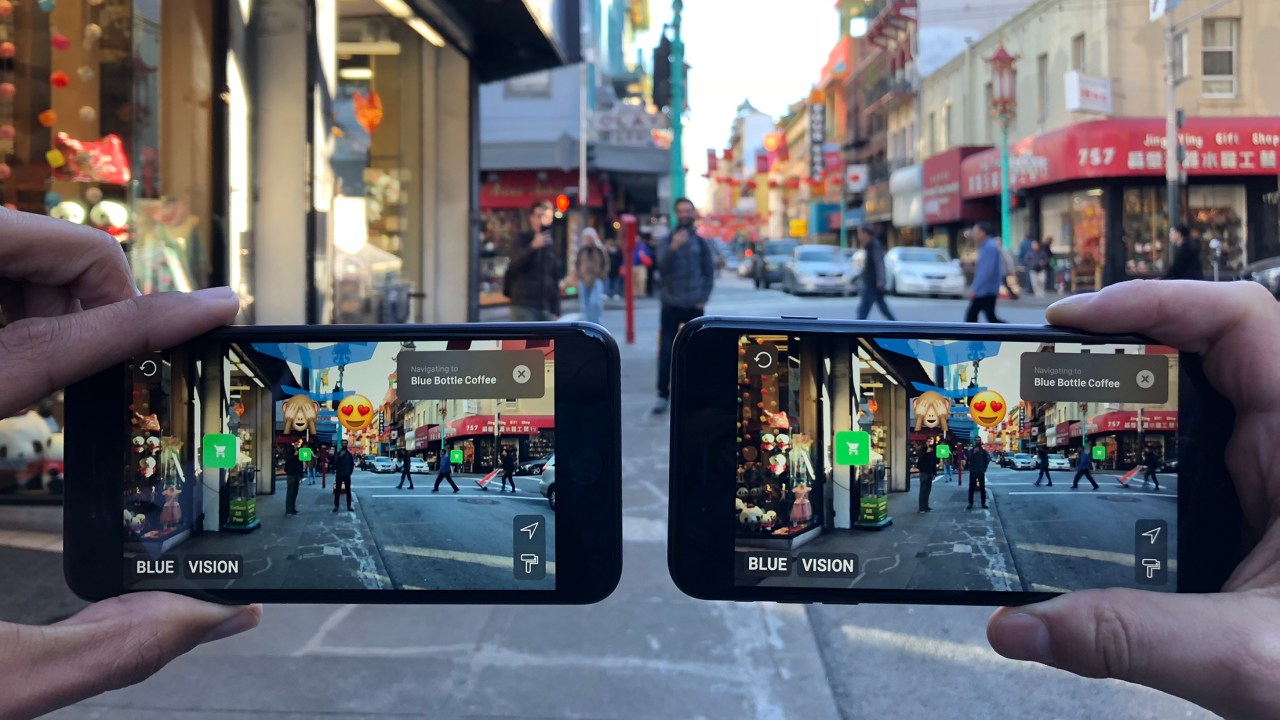
In a world rapidly embracing digital transformations, augmented reality (AR) is paving the way for innovative interactions that blur the lines between the physical and virtual realms. Among the frontrunners in this exciting wave of technological advancement is Blue Vision Labs, a London-based startup that has emerged from stealth mode with a groundbreaking proposition: a platform that fosters ‘collaborative’ AR experiences. With a recent funding boost of $14.5 million led by Alphabet’s GV, the potential of Blue Vision Labs and its platform has set the stage for a new era of AR applications.
Collaboration in Augmented Reality
Unlike conventional AR applications that offer single-user experiences, Blue Vision Labs takes a significant leap forward by enabling multiple users to interact with shared virtual objects in a spatially-accurate environment. Imagine walking down a bustling city street with friends, all able to simultaneously see and interact with virtual objects that enhance your navigation experience or enrich your gaming interactions. The technology harnesses advanced computer vision systems originally developed by experts from prestigious institutions like Oxford and Imperial College, delivering accuracy to within centimeters—far exceeding typical GPS capabilities.
Potential Applications: Beyond Gaming
The implications of such innovative technology extend well beyond entertainment. Here are some potential use cases:
- Educational Tools: Imagine students collaborating on a complex project while viewing shared 3D models of scientific structures or historical artifacts, enhancing their learning experience.
- Navigation Ease: The platform can revolutionize how users navigate urban environments, ensuring precise location tracking to locate meeting points seamlessly in crowded areas.
- Social Media Interaction: Integrating shared AR experiences could lead to new forms of digital interaction, creating communal spaces where users can engage in real-time with shared content.
Barriers Broken with Accessible Technology
One of the standout features of Blue Vision Labs is its approach to accessibility. Unlike other AR platforms that require specialized hardware, their technology operates effectively on standard smartphones. This lowers the entry barrier significantly, inviting broader adoption. The integration of advanced algorithms and back-end systems guarantees an immersive experience without necessitating high-end devices. As Tom Hulme from GV aptly noted, “They have reduced the need for specific, tailored hardware,” which could lead to wider acceptance and engagement in the mass market.
Mapping the Future of AR
Blue Vision Labs has laid the groundwork for its platform by constructing detailed maps of major city centers, such as London, San Francisco, and New York. These maps serve as canvases for augmented interactions, allowing developers to build unique AR environments. Furthermore, users will have the autonomy to create their own locations dynamically, enhancing customization and interaction during the AR experience. However, this capability may have limitations in fast-paced environments, highlighting the balance between flexibility and accuracy in AR applications.
The Road Ahead
While there’s a general consensus about the potential for AR and VR applications to generate substantial revenue—projected to hit upwards of $90 billion in coming years—the technology still has obstacles to overcome in achieving widespread acceptance. Ondruska believes that the previous limitations lay in the single-user dynamic that has hampered innovation. Blue Vision Labs aims to redefine this paradigm by filling the existing gaps in technology. Their bold ambition is to create practical AR use cases that seamlessly blend into daily life, making collaborative experiences an integral part of our interactable environment.
Conclusion: A New Horizon for AR
With its unique collaborative approach, Blue Vision Labs is poised to radically reshape the AR landscape. Their technology doesn’t just address existing limitations—it challenges the very nature of how we perceive and interact with augmented experiences. As we stand on the cusp of this transformation, it is clear that the future of AR could become a vibrant collaborative space, enabling users to connect in ways previously unimagined.
At fxis.ai, we believe that such advancements are crucial for the future of AI, as they enable more comprehensive and effective solutions. Our team is continually exploring new methodologies to push the envelope in artificial intelligence, ensuring that our clients benefit from the latest technological innovations. For more insights, updates, or to collaborate on AI development projects, stay connected with fxis.ai.