
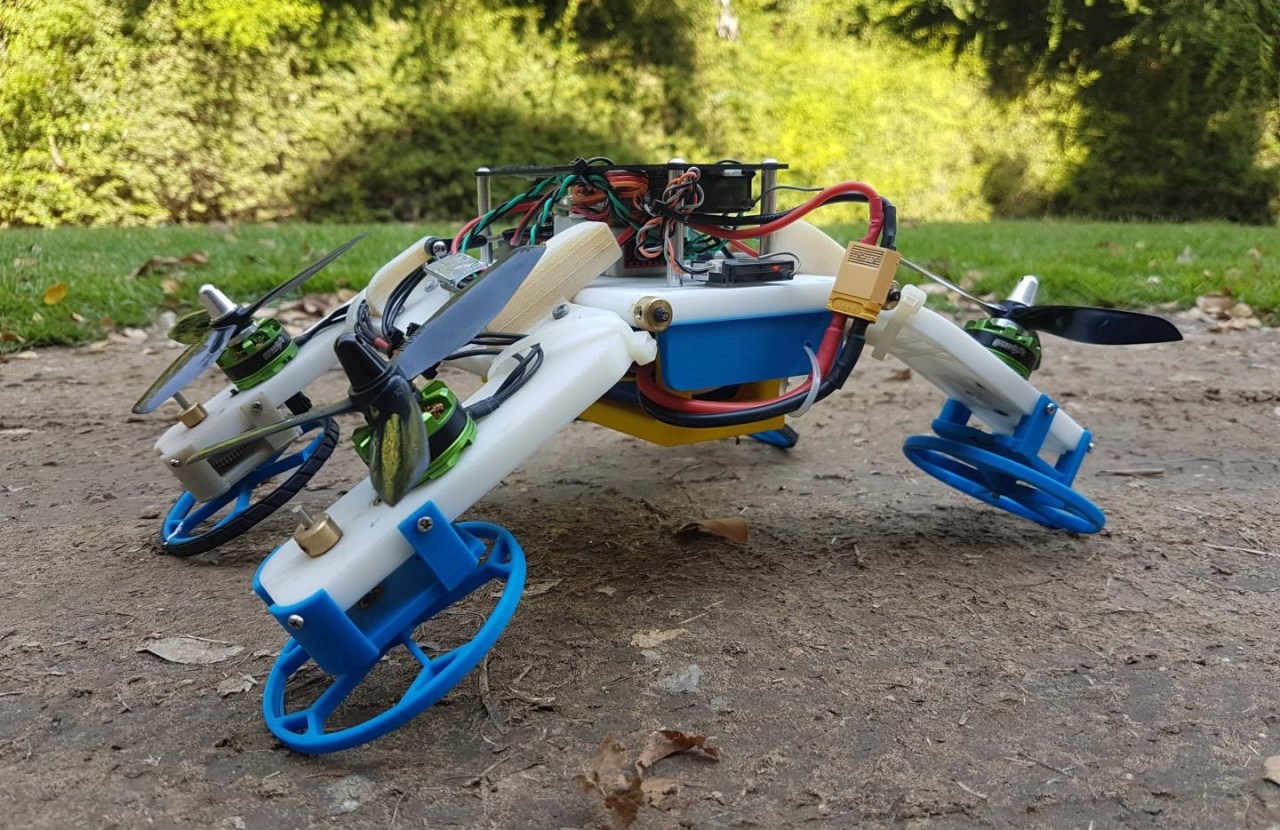
In an era where innovation seems limitless, researchers are continually working towards breakthroughs that reshape our understanding of mobility. One of the latest marvels in robotics is the “Flying STAR” (Sprawl-Tuned Autonomous Robot), a remarkable creation from the creative minds at Ben-Gurion University in Israel. This hybrid robot is not just another drone; it cleverly combines the aerial abilities of a drone with the terrestrial capabilities of ground robots, opening new pathways for diverse applications such as disaster response and exploration. Let’s dive deeper into how this dual-functionality works and what it means for the future.
The Ingenious Design Behind the Flying STAR
At the core of the Flying STAR’s design is a fundamental insight: both rotors and wheels rotate. Researchers noticed this simple yet potent observation and asked themselves, “Why can’t a vehicle have both?” This conceptual leap was key, but translating it into a functioning mode of transportation was no easy feat. The engineering team, led by David Zarrouk, successfully overcame several challenges using modern lightweight drone components that allow for enhanced energy efficiency and performance.
Mechanics of Flight and Roll
When it comes to traditional drones, their flying capabilities often come at the expense of ground mobility. However, the Flying STAR flips this paradigm. By utilizing a mechanism that tilts its rotor arms downwards, the robot effectively transforms from flying to rolling effortlessly. This dual operation is not only innovative but also mechanically efficient, as the same motor skillfully powers both its rotors and wheels, albeit at different RPMs for each mode.
Benefits of the Flying STAR’s Design
- Energy Efficiency: With the ability to travel on the ground at speeds of up to 8 feet per second, the Flying STAR utilizes significantly less energy compared to traditional flying drones.
- Versatility: This robot can leap over obstacles, ascend stairs, or simply take to the skies, making it adaptable for rough terrain scenarios.
- Stability: The rotating arms provide a flexible stance with a large wheelbase and high clearance, further enhancing its navigation capabilities.
Real-World Applications
The potential for the Flying STAR extends far beyond just a prototype. As research continues, there are exciting prospects for this robot in critical areas such as disaster response, search and rescue missions, and military operations. Each application would benefit hugely from a versatile machine that can traverse various environments, whether it’s accessing hard-to-reach areas in urban settings or navigating through rugged terrains in remote locations.
Zarrouk mentioned plans to develop both larger and smaller variants of the Flying STAR, targeting different operational needs. This visionary approach hints at a future where fleets of these robots could operate alongside human teams, significantly enhancing emergency response capabilities.
Looking Ahead
As we witness advancements in robotics and AI, the emergence of innovative solutions like the Flying STAR reminds us of the limitless possibilities that lie ahead. The intricate design marries functionality and adaptability, tackling real-world challenges faced by rescue teams and providing a glimpse into how technology can save lives.
At fxis.ai, we believe that such advancements are crucial for the future of AI, as they enable more comprehensive and effective solutions. Our team is continually exploring new methodologies to push the envelope in artificial intelligence, ensuring that our clients benefit from the latest technological innovations.
In conclusion, the Flying STAR stands at the intersection of innovation and practicality, blending flying and rolling into one harmonious machine. It brings forth a promising future where robotics play a vital role in emergency situations and beyond. For more insights, updates, or to collaborate on AI development projects, stay connected with fxis.ai.