
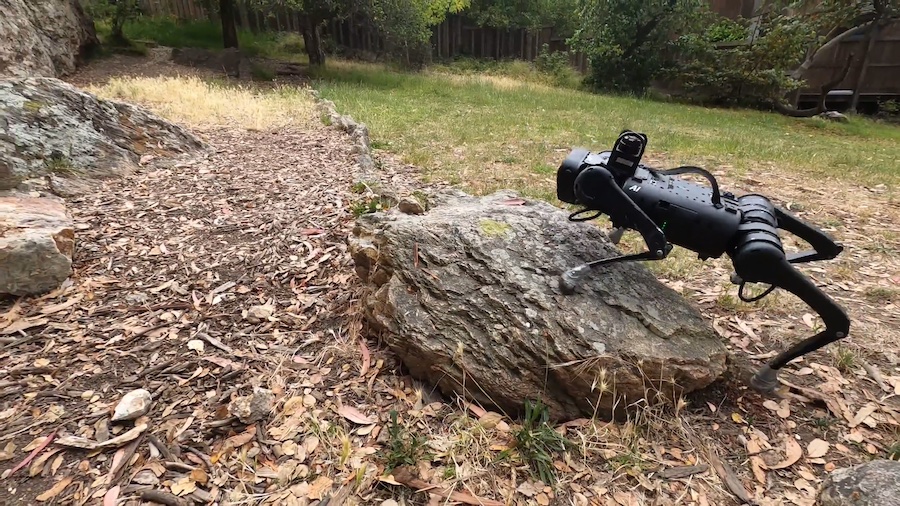
As technology continues to evolve rapidly, one domain stands out for its complexity and potential—the development of robotic systems that can navigate varying terrains with agility and resilience. Among the frontrunners in this area is a remarkable robotic dog, engineered by a collaboration between researchers at Carnegie Mellon University and UC Berkeley. Forget about the simple, robotic pets of yesteryears; this advanced quadruped is designed to traverse the toughest environments, whether it be stairs, curbs, or slippery surfaces.
Pioneering Adaptive Robotics
With the rise of advanced robotic designs, the quest for a solution that performs reliably across diverse terrains has intensified. Researchers at the collaborative institutions have approached this challenge by adopting a novel strategy that leverages the power of simulation. Instead of relying on traditional camera systems for mapping, the team engineered a method using thousands of virtual clones. This virtual testing ground allowed the robotic dog to undergo extensive training, effectively simulating six years’ worth of real-world walking experience within just a single day. The ability to simulate different terrains rapidly gives this robot an edge in adaptability.
A Learning Approach: Neural Networks on Four Legs
Once the team compiled the data from their simulations, they utilized it to train a complex neural network. Now equipped with a sophisticated on-board learning system, the robotic dog can react intuitively to its surroundings in real time. “This system uses vision and feedback from the body directly as input to output commands to the robot’s motors,” noted researcher Ananye Agarwal. This innovative approach enables the quadruped to not only interact with its environment but also recover from potential mishaps, such as slipping on stairs.
Nature-Inspired Engineering
Inspired by the agility of real-world animals, particularly four-legged creatures like cats, this quadruped robot employs a memory system that mimics how mammals coordinate their movements. Assistant professor Deepak Pathak aptly points out that this feature allows the hind legs of the robotic dog to track and follow the movements of its front legs, leading to smoother navigation. Such motion mimics natural biological processes, showcasing the potential for biomimicry in robotic design.
Versatile Operation: Climbing and Navigating in Darkness
One of the standout features of this robotic marvel is its capability to climb stairs that are nearly its own height. Beyond simply overcoming barriers, this robot is devised to function effectively in low-light conditions, although its performance improves substantially with enhanced visual input. This dual functionality highlights the breadth of environments in which it can operate, further solidifying its utility in practical applications.
Cost-effective Advancements for the Future
Developing such resilient robotic technologies has traditionally been an expensive endeavor. However, with these advancements, researchers propose that the cost of similar robots could be significantly reduced. This democratization of technology opens doors for deployment in various fields, from construction to navigation in search and rescue missions, expanding the usefulness of robotic systems in everyday scenarios.
Conclusion: Bridging the Gap Between Design and Application
The journey of developing robotic dogs capable of navigating complex terrains reflects not just technological progress, but a principled approach to solving real-world challenges. These advancements herald a new era of robotics focused on adaptability and resilience, making them suitable companions, colleagues, or aids in unpredictable environments.
At fxis.ai, we believe that such advancements are crucial for the future of AI, as they enable more comprehensive and effective solutions. Our team is continually exploring new methodologies to push the envelope in artificial intelligence, ensuring that our clients benefit from the latest technological innovations. For more insights, updates, or to collaborate on AI development projects, stay connected with fxis.ai.