
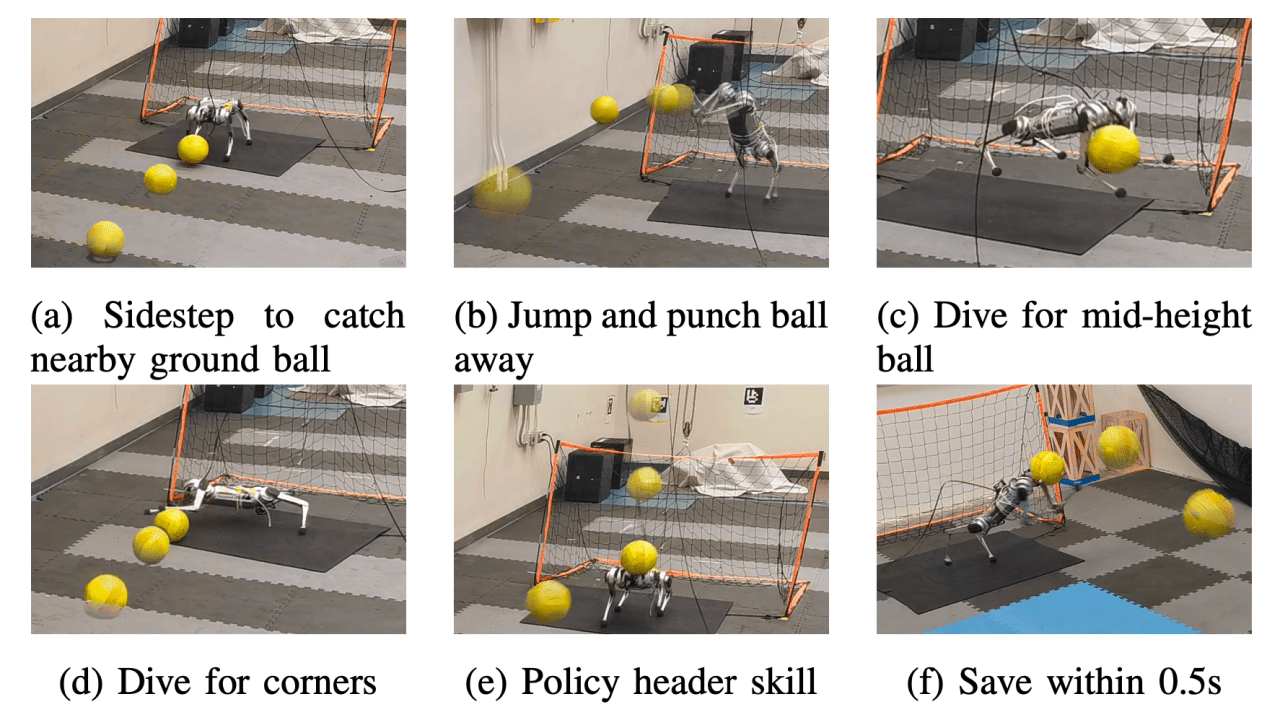
Imagine a world where small robots not only serve us in various capacities but also engage in sports, much like humans. The recent developments around MIT’s Mini Cheetah robot have taken this notion a step further, showcasing how advanced robotics combined with reinforcement learning can lead to impressive feats, such as playing soccer. This innovative approach goes beyond mere entertainment; it addresses larger challenges in robotics and artificial intelligence. In this blog post, we will explore the exciting realm of robotic soccer, its underlying techniques, and the potential applications of these advancements.
Unraveling the Challenge of Robotic Goalkeeping
The task of soccer goalkeeping, especially for quadrupedal robots like the Mini Cheetah, is a significant challenge that involves a blend of dynamic locomotion and precise interaction with moving objects – in this case, a soccer ball. The authors of a recent study note that successfully intercepting a fast-moving ball that could be heading towards the goal requires quick reactions and sophisticated maneuvers, all within less than one second!
To tackle this complex task, researchers implemented a hierarchical model-free reinforcement learning (RL) framework. This method allows the Mini Cheetah to develop excellent reflexes and decision-making skills, ultimately enabling the robot to engage in real-time action on the field. It is thrilling to see how AI can be trained to perform in such dynamic environments, with applications not just limited to soccer but broadening into various realms of robotics.
Dynamic Locomotion: The Trio of Moves
In order to defend its goal, the Mini Cheetah employs a sophisticated combination of movements: sidestep, dive, and jump. These maneuvers are critically timed to align with the projected trajectory of the soccer ball. The robot’s parameters are meticulously defined in an emulator, allowing it to simulate different scenarios before implementing them in real-world situations.
- Sidestep: This move allows the Mini Cheetah to quickly reposition itself sideways to address the trajectory of the incoming ball.
- Dive: A rapid dive puts the robot in the path of the ball, aiming for maximum interception potential.
- Jump: The ability to jump enhances the robot’s reach, particularly for higher projectiles.
This versatility enables the robot to adapt its strategy on-the-fly, highlighting the richness of its learning experience.
Testing the Limits: Robots vs. Humans
In testing the performance of the Mini Cheetah, researchers pitted it against human players as well as other Mini Cheetah robots. These trials not only assess the effectiveness of the goalkeeping framework but also emphasize the robot’s ability to learn from varied interactions. Such competitive settings offer invaluable data, refining the robot’s algorithms while showcasing the potential for complex team dynamics, reminiscent of human soccer matches.
Looking Ahead: Beyond Goalkeeping
While the current focus is on goalkeeping, the methodologies demonstrated in this study are variably applicable. The authors note that this framework can be extended to other exciting challenges, such as ball kicking and multi-skill performance scenarios. The implications for this technology could extend well beyond soccer, permeating fields like search and rescue operations, robotic companionship, and even autonomous drones.
In a world increasingly influenced by AI, the evolution of robot skills reshapes how we envision the capabilities of artificial entities in our everyday lives.
Conclusion
As we dive deeper into the intersection of robotics and sports, it becomes evident that projects like MIT’s Mini Cheetah are more than just fascinating displays of technology. They represent significant advancements in the understanding and implementation of AI in dynamic environments. By utilizing tools like reinforcement learning, we are inching closer to creating robots that can respond effectively to unpredictable situations, making them highly versatile companions across various industries.
At [fxis.ai](https://fxis.ai/edu), we believe that such advancements are crucial for the future of AI, as they enable more comprehensive and effective solutions. Our team is continually exploring new methodologies to push the envelope in artificial intelligence, ensuring that our clients benefit from the latest technological innovations. For more insights, updates, or to collaborate on AI development projects, stay connected with [fxis.ai](https://fxis.ai/edu).