
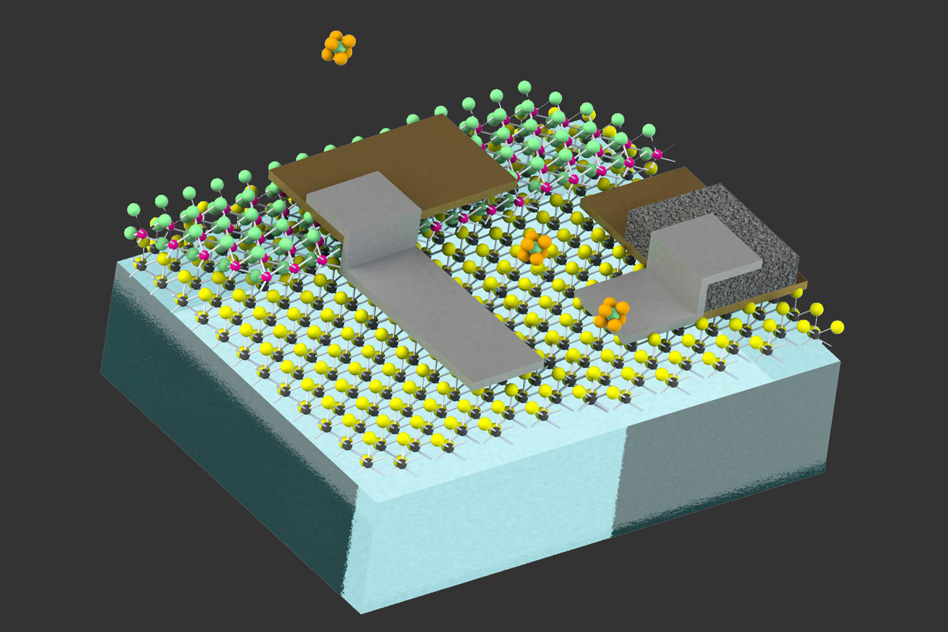
In an era where technology constantly pushes the boundaries of human capability, researchers at MIT have embarked on a truly groundbreaking journey. They have engineered self-powered robots that are not only diminutive in size—roughly the dimensions of a human egg cell—but also exhibit remarkable functionality. The implications of this innovation are vast, promising significant advancements in both medical diagnostics and industrial monitoring. Let’s dive deeper into these micro marvels and explore how they could reshape our approach to some critical systems.
The Genesis of Miniature Robotics
The MIT team has ingeniously attached cutting-edge 2D electronics to colloidal particles, yielding robots that can float “indefinitely” in air. This achievement is not merely a testament to electronic engineering but also to the art of miniaturization. Measuring between one-billionth to one-millionth of a meter, these microscopic devices can navigate spaces that larger machinery would find inaccessible.
Light as a Power Source: The Role of Photodiode Semiconductors
A standout feature of these tiny robots is their self-sufficiency. By integrating photodiode semiconductors, they can convert ambient light into a usable electrical charge, eliminating the dependence on traditional batteries. This innovation not only enhances their operational longevity but also opens up avenues for deployment in diverse environments. The ability to power themselves using natural or artificial light is a game-changer in the field of robotics.
- Environmental Monitoring: Their ability to maintain continuous operation allows them to serve as sensors that monitor environmental conditions. Whether it is the human body or pipelines, these robots offer real-time data collection.
- Data Collection in Confined Spaces: With the capability to traverse challenging environments, these robots could collect vital information from areas that were once deemed difficult or impossible to reach.
Applications in Healthcare and Industry
So, what are the potential use cases for such microscopic robots? The research team envisions a dual-focus deployment:
- Human Body: These robots could embark on exploratory missions through the digestive system, enabling non-invasive diagnostics. Imagine a future where gastrointestinal disorders could be monitored internally without the discomfort of traditional endoscopy.
- Pipelines: The oil and gas industry could greatly benefit from this technology, where these robots might be sent into pipelines to monitor health, integrity, and flow dynamics, while preventing catastrophic failures.
Once deployed, the data collected by these tiny sentinels can be downloaded and analyzed, making the potential for early diagnostics in patients and efficient monitoring in industrial settings more attainable than ever before.
Challenges and Future Prospects
While the possibilities are exhilarating, challenges remain. Careful consideration must be given to the programming and deployment methods of these robots to ensure effective data collection and retrieval. Furthermore, researchers will need to find ways to enhance their navigation capabilities in complex environments.
Nonetheless, the convergence of micro-robotics and self-powered technology marks a pivotal moment in the evolution of robotics. As research continues, we may see these innovations find their way into real-world applications, bridging the gap between science fiction and reality.
Conclusion: A New Era of Robotics
Self-powered robots the size of human cells represent a leap forward in how we might interact with and monitor various ecosystems, from industrial to biological. The advent of such technology is not just a remarkable accomplishment but an indicator of what the future holds for engineering and healthcare.
At fxis.ai, we believe that such advancements are crucial for the future of AI, as they enable more comprehensive and effective solutions. Our team is continually exploring new methodologies to push the envelope in artificial intelligence, ensuring that our clients benefit from the latest technological innovations.
For more insights, updates, or to collaborate on AI development projects, stay connected with fxis.ai.