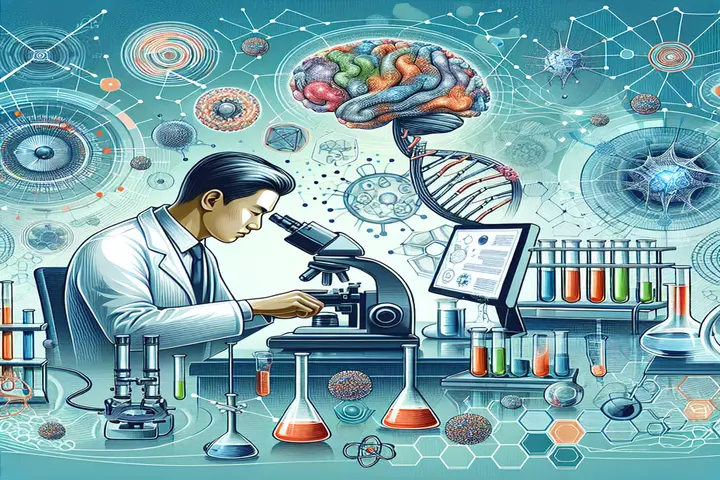
Hey there! I’ve been thinking a lot about how artificial intelligence is weaving itself into the fabric of our everyday lives, especially in the fascinating world of biomedical research. Today, I want to share my thoughts on BiomedCLIP—not just as another tech tool, but as a game-changer in how we interact with biomedical data. I hope you find this journey as intriguing as I do!
Why BiomedCLIP Caught My Attention
Have you ever found yourself lost in a sea of research articles and images, trying to find that one crucial piece of information? I remember a time when I was knee-deep in histopathology slides, feeling overwhelmed by the complexity of it all. That’s when I stumbled upon BiomedCLIP. It felt like discovering a reliable friend who helps you navigate through the chaos. This tool, trained on around 15 million figure-caption pairs from biomedical literature, is designed to transform our approach to searching for information, categorizing images, and tackling visual questions. It’s truly something worth exploring!
What Makes BiomedCLIP Stand Out
1. Tailored for Biomedicine: Unlike many AI models that attempt to cover various fields, BiomedCLIP zeroes in on the unique challenges of biomedicine. This focus means it can excel where other tools might struggle, and that’s something we can all appreciate.
2. Impressive Performance: If BiomedCLIP were an athlete, it would definitely be the star player—always delivering results that impress. It’s not just another tool; it’s raising the bar for how we handle biomedical data.
3. New Horizons: Whether you’re navigating the intricacies of histopathology images or enhancing practices in radiology, BiomedCLIP opens up fresh perspectives on interpreting and managing biomedical data. It’s like seeing familiar information through a new lens.
The Real-World Impact of BiomedCLIP
Let’s get a little more personal. Picture yourself as a pathologist, carefully examining a challenging histopathology slide. In those moments, BiomedCLIP can be your supportive colleague, helping you accurately identify conditions like squamous cell carcinoma or adenocarcinoma. I recall a colleague who struggled with a particularly tricky case; introducing BiomedCLIP into her workflow not only eased her burden but also improved patient outcomes. In radiology, it assists in spotting subtle differences in chest X-rays, ensuring that diagnoses are precise. Ultimately, it’s about enhancing patient care—because that’s what truly matters, right?
A Peek Behind the Curtain: How BiomedCLIP Works
Let’s take a moment to appreciate the technology that powers BiomedCLIP:
- Text Encoder: At its core is PubMedBERT, a powerful tool designed to process biomedical literature. Think of it as a savvy librarian who knows just where to find the information you need.
- Image Encoder: The Vision Transformer excels at analyzing images, ensuring visual data is interpreted accurately. Imagine it as a discerning art critic, picking up on the subtleties of each piece.
- Contrastive Learning: This technique allows BiomedCLIP to understand the relationship between images and their descriptions, enriching its grasp of the data. It’s a bit like teaching a child to connect pictures with stories—they start to see the bigger picture.
Ready to Dive into BiomedCLIP?
If you’re curious about trying BiomedCLIP, here’s a simple guide to get you started:
1. Set Up Your Environment: Kick things off with Python 3.10 and install essential packages like `open_clip_torch` and `transformers`. Think of this as prepping your workspace before diving into a new project.
2. Access the Model: You can find BiomedCLIP on the Hugging Face Hub, where it’s ready for you to explore its zero-shot image classification features. It’s like opening a treasure chest filled with possibilities.
3. Experiment: Dive in with various biomedical images and see how well it classifies them. It’s a hands-on way to appreciate its capabilities!
A Few Things to Keep in Mind
While BiomedCLIP is impressive, it’s essential to recognize its limitations. For instance, it’s primarily trained on English-language data, which might affect its effectiveness with materials in other languages. Additionally, its current focus is on research, so commercial applications are still in development.
In Summary
BiomedCLIP represents a significant leap forward in how we process and understand biomedical information. As researchers continue to refine this tool, I’m excited to see what developments emerge in biomedicine. Whether you’re a researcher, clinician, or just someone curious about AI’s potential, BiomedCLIP beautifully illustrates how integrating vision and language can deepen our understanding of complex data.
Thanks for joining me on this exploration of BiomedCLIP! I hope you found this discussion as captivating as I do. Let’s keep the conversation going about the evolving role of technology in our field!