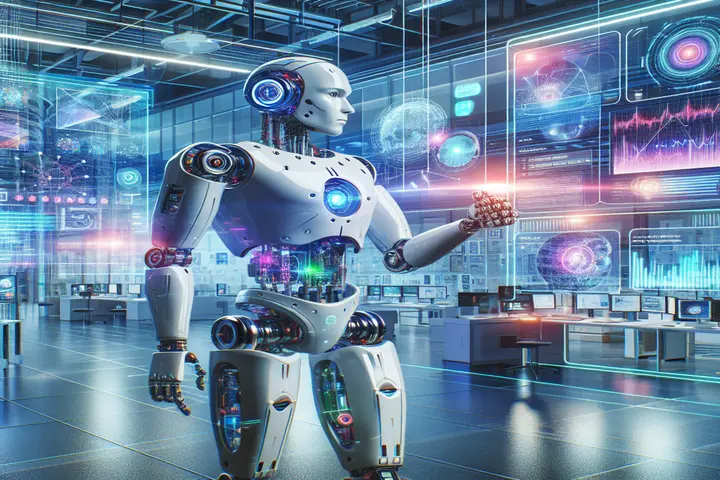
Have you ever considered how robots interpret and perform tasks based on straightforward language commands? Introducing OpenVLA 7B, a pioneering vision-language-action model that is redefining the capabilities of robotic systems. Developed collaboratively by a remarkable team from Stanford, UC Berkeley, Google DeepMind, and the Toyota Research Institute, this open-source model is engineered to process both language instructions and visual inputs from cameras to produce accurate robotic actions. Let’s explore the transformative potential of OpenVLA 7B in the realm of robotics.
Understanding OpenVLA 7B
OpenVLA 7B stands at the forefront of AI innovation, having been trained on a substantial dataset consisting of 970,000 robot manipulation episodes from the [Open X-Embodiment](https://robotics-transformer-x.github.io) collection. Its capabilities extend beyond mere language comprehension; it effectively translates this understanding into actionable commands for robots. The model is capable of controlling multiple robotic systems with minimal configuration and can be easily fine-tuned for new robotic domains.
Model Overview
- Developed by: A collaborative effort from leading research institutions
- Model Type: Vision-language-action
- Pretraining Dataset: The comprehensive Open X-Embodiment dataset
- License: MIT (ensuring broad accessibility for further innovation)
Mechanism of Action
At its essence, OpenVLA 7B processes inputs consisting of language commands paired with images of the robot's operational environment. The model’s output comprises normalized actions that dictate the robot's movements. These actions are articulated using a 7-DoF (Degrees of Freedom) format, which includes spatial coordinates and adjustments for the robot's gripper.
To implement these actions on physical robots, additional steps are necessary to unnormalize the output according to specific robot parameters. While OpenVLA provides a robust framework, some degree of customization is essential to accommodate various robotic setups and environmental contexts.
Getting Started with OpenVLA 7B
Initiating your journey with OpenVLA 7B is quite simple. Below is a brief example illustrating how to load the model for zero-shot instruction following in the BridgeV2 environments using a Widow-X robot:
# Install minimal dependencies (torch, transformers, timm, tokenizers, ...) pip install -r https://raw.githubusercontent.com/openvla/openvla/main/requirements-min.txt from transformers import AutoModelForVision2Seq, AutoProcessor from PIL import Image import torch # Load Processor vla_processor = AutoProcessor.from_pretrained("openvla/openvla-7b", trust_remote_code=True) vla = AutoModelForVision2Seq.from_pretrained( "openvla/openvla-7b", attn_implementation="flash_attention_2", # [Optional] Requires flash_attn torch_dtype=torch.bfloat16, low_cpu_mem_usage=True, trust_remote_code=True ).to("cuda:0") # Acquire image input image: Image.Image = get_from_camera(...) # Replace with actual image acquisition method prompt = "In: What action should the robot take to INSTRUCTION?" # Predict Action (7-DoF; un-normalize for BridgeV2) inputs = vla_processor(prompt, image).to("cuda:0", dtype=torch.bfloat16) action = vla.predict_action(**inputs, unnorm_key="bridge_orig", do_sample=False) # Execute... robot.act(action, ...)
This code snippet demonstrates how to effectively set up OpenVLA 7B for engaging with robotic systems, facilitating immediate and practical applications.
Real-World Applications and Considerations
OpenVLA 7B excels in environments that closely mirror those represented in its pretraining data. It can be applied across a range of robotic tasks, from assembly lines to service roles in hospitality. However, it is crucial to recognize that the model may not generalize effectively to entirely new robotic embodiments. If your robot setup deviates from those included in the pretraining dataset, gathering demonstration data and fine-tuning the model will be necessary.
The Significance of OpenVLA 7B
The implications of OpenVLA 7B are profound. By equipping robots with the ability to comprehend and act upon natural language commands, we are advancing toward a future where interactions between humans and robots become seamless and intuitive. This technology holds immense potential across various domains, including industrial applications, healthcare, and everyday life.
Conclusion
OpenVLA 7B represents more than just another tool in the robotics toolkit; it signifies a significant advancement toward making robots more accessible and proficient in understanding human instructions. As we continue to refine and expand upon models like OpenVLA, we are paving the way for a future where robots can assist us in ways we have only imagined.
For further insights, I encourage you to visit the [OpenVLA project page](https://openvla.github.io) and explore the possibilities offered by this groundbreaking technology!